
Key Takeaways
- On October 26, 2026, Microsoft announced a time-limited Voluntary Exit Offer for employees at level 70 and below in participating teams in the US, Canada, India and the UK.
- About 60,000 employees are eligible, roughly a quarter of the company, according to Bloomberg, Reuters and CNBC reporting from October 26, 2026. Microsoft's own post gives no number.
- Employees have until early December to decide, and those who accept leave on December 31, 2026, according to the same reports. A Microsoft spokesperson told KUOW the package is comparable to standard severance.
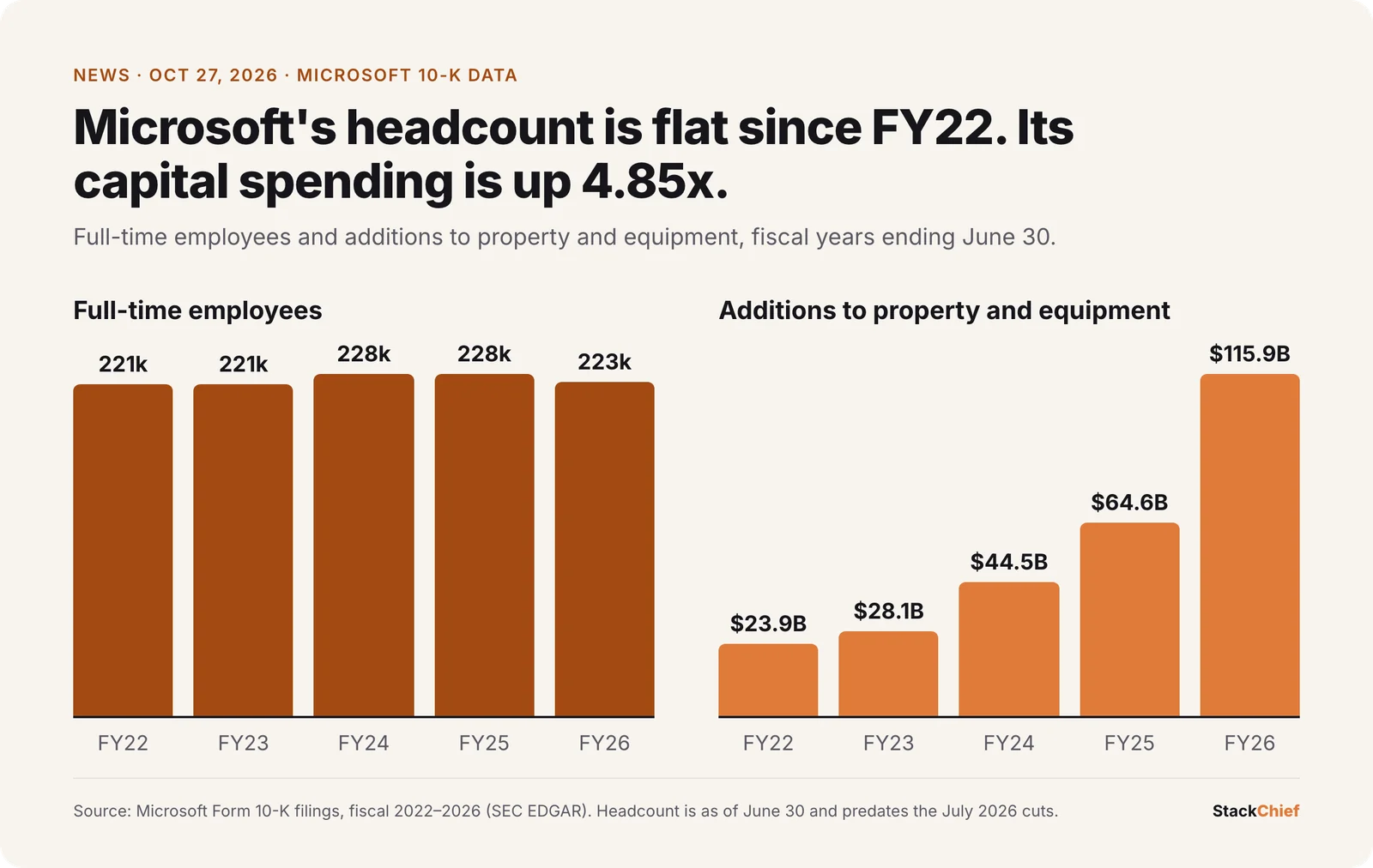
- Microsoft's 10-K filings show 223,000 full-time employees on June 30, 2026, against 221,000 four years earlier. Over the same years, spending on property and equipment rose from $23.9 billion to $115.9 billion.
- It's Microsoft's third workforce reduction of 2026, after a voluntary retirement program in the spring and 4,800 job cuts announced on July 6, 2026.
The Microsoft voluntary buyout 2026 offer, announced on October 26, 2026, is the largest exit offer a big tech employer has made this year, by number of people eligible. About 60,000 Microsoft employees can take a severance-style package and leave on December 31. For software engineers, it matters in two ways. If you work at Microsoft, you may have a decision to make by early December. If you don't, you may soon be competing with a larger pool of experienced engineers for the same openings.
What happened
Amy Coleman, Microsoft's chief people officer, sent employees a memo on Monday, October 26, 2026. Microsoft republished it on its official blog. The offer is open to "eligible employees in participating teams" in Canada, India, the United Kingdom and the United States "at level 70 and below". Coleman describes it as "a new choice to make that transition now with support". Bloomberg and Reuters reported the size of the offer, citing people familiar with it. CBS News and KUOW carried the same figures the same day.
The Microsoft voluntary buyout 2026 offer: what's confirmed and what's reported
The memo is short. Most of the numbers come from reporting, not from Microsoft. Here's what each source says.
| Detail | What we know | Source |
|---|---|---|
| Who is eligible | Level 70 and below, in participating teams, in the US, Canada, India and the UK | Microsoft (memo) |
| Which teams | "Some organizations are providing the Voluntary Exit Offer, and some are not." | Microsoft (memo) |
| What's in it | Financial support and career planning resources; terms sent to each person by email | Microsoft (memo) |
| How many people | About 60,000, roughly a quarter of the workforce | Bloomberg, Reuters, CNBC |
| Deadline | Decide by early December; leave December 31, 2026 | CNBC, Reuters |
| Package size | Comparable to standard severance: base pay for a period based on tenure, stock, health care, career planning | Microsoft spokesperson to KUOW |
| Participating teams | AI experiences, Copilot, Xbox, Windows + Devices, finance | Reuters, via Computerworld |
| Excluded teams | Marketing, sales, commercial business, security, some data center staff | Reuters, via Computerworld and ITPro |
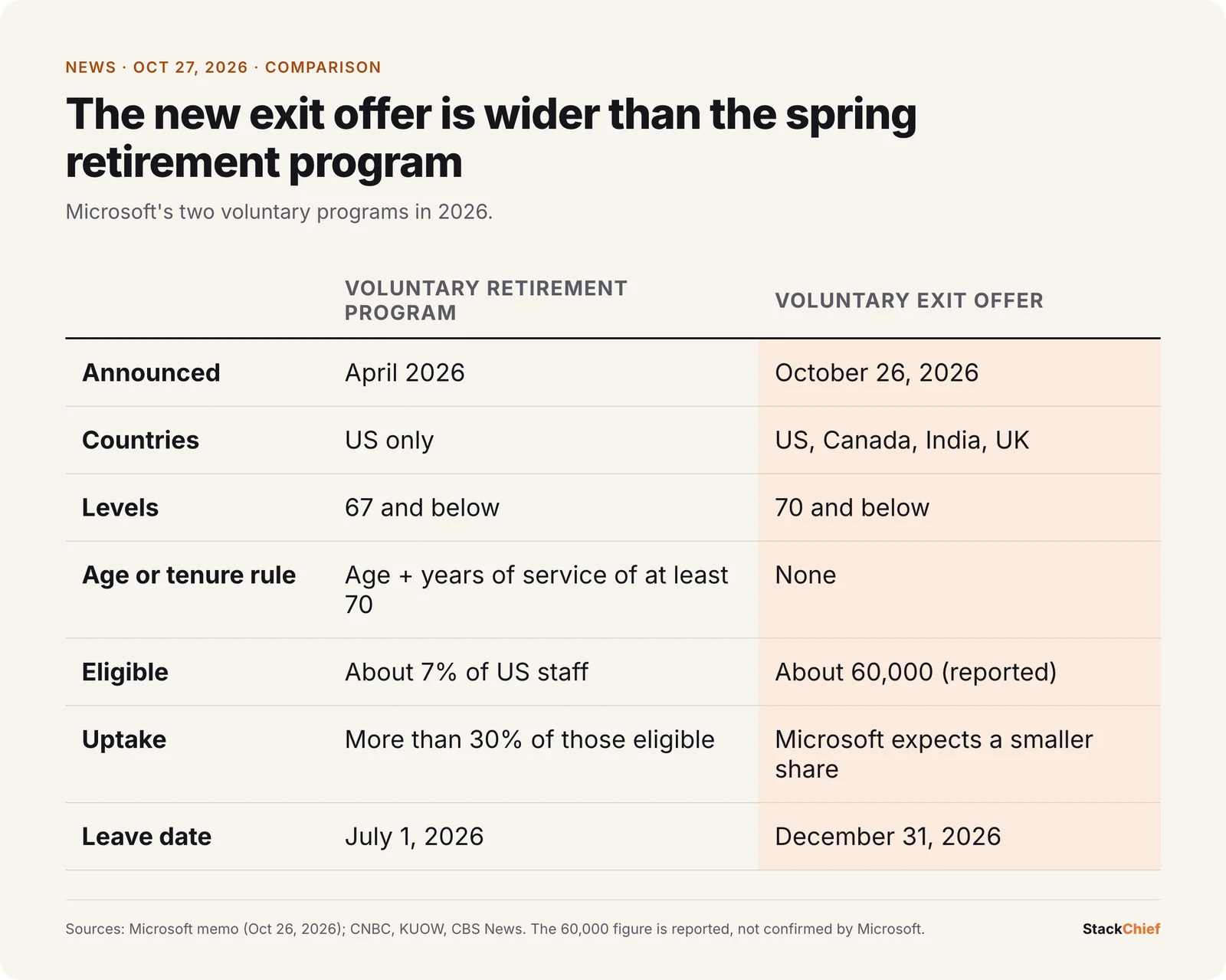
Two details stand out for engineers. First, product engineering groups are on the participating list, including the teams building Copilot. KUOW also reported that some engineering teams are not participating. So whether you're eligible depends on your organization, not on your job title. Second, level 70 is high on Microsoft's ladder. The spring program stopped at level 67. This offer reaches up to the vice president level, according to KUOW.
How it differs from the spring voluntary retirement program
This is Microsoft's second voluntary program of 2026. In April, it offered voluntary retirement to US employees at level 67 and below whose age plus years of service added up to at least 70. That was about 7% of the US workforce. In July, Microsoft said more than 30% of those eligible had accepted. KUOW reports that Microsoft expects a smaller share of eligible employees to take the new offer, partly because the retirement terms were more generous. The new offer has no age or tenure condition. It covers four countries, not one, and it's open to far more people.
The numbers behind it
Microsoft's annual 10-K filings give the base. The company had about 223,000 full-time employees on June 30, 2026: 121,000 in the US and 102,000 elsewhere. That's down from 228,000 a year earlier. Sixty thousand is 26.9% of 223,000, which matches the "about a quarter" in the reports.
The chart above shows the longer trend. Headcount was 221,000 in fiscal 2022 and 223,000 in fiscal 2026, so it's been close to flat for four years. Additions to property and equipment, which is mostly data centers and servers, went from $23.9 billion to $115.9 billion over the same period. That's 4.85 times as much. In fiscal 2026 alone, the spending rose 79.6% while headcount fell 2.2%.
The data has limits. The two lines move in opposite directions, but the filings don't connect them. A Microsoft spokesperson told KUOW that AI is not what's driving the buyout programs. In July, Coleman said jobs at Microsoft aren't being replaced by AI. Also, the June 30 headcount was counted before both the retirement exits (last day July 1) and the 4,800 cuts announced on July 6, so the current number is likely lower than 223,000. Microsoft hasn't published a newer one.
Microsoft's 2026 workforce reductions so far
- April: voluntary retirement offered to about 7% of US staff. More than 30% of those eligible accepted.
- July 6: 4,800 jobs cut, about 2% of the global workforce, many of them in Xbox (CNBC).
- October 26: the Voluntary Exit Offer, with about 60,000 eligible.
What this means for you
If you're an engineer at Microsoft
- Read the email terms against your vesting dates. A spokesperson says the package is comparable to standard severance, which is based on tenure. The value of leaving December 31 depends on which stock grants vest before then.
- Find out whether your organization is participating before assuming you're in or out. The memo says some organizations aren't offering it.
- Don't read the offer as a guarantee. The memo doesn't say what happens to teams that don't reach their targets through voluntary exits, and Microsoft has done involuntary cuts this year too.
- If you're thinking of leaving anyway, start interviewing before the December deadline. That way you know what's out there while the offer is still open.
If you're job hunting outside Microsoft
- Expect more experienced candidates in early 2027. If even a small share of 60,000 people take the offer, thousands of engineers from Microsoft's product groups would be looking for work at the start of 2027. That matters most around Seattle, where Microsoft is based: Indeed's October snapshot already put Seattle's local job postings index at 67, among the lowest in the country (Indeed Hiring Lab).
- Remember that postings nationally are still rising. Indeed's US software development postings index was 78.86 on October 16, 2026, up 21.3% from a year earlier (FRED). Most of the growth has been in senior roles: they made up 71% of the increase from May 2025 to May 2026 (Indeed Hiring Lab).
- Don't wait for January. Applications you send in November and December reach recruiters before people leaving on December 31 are on the market.
How this connects
Our software engineer job market 2026 analysis found that layoffs and hiring are both up this year, and that senior roles account for most new postings. Microsoft's offer is the same pattern at one company: fewer people, more spending on infrastructure, and the cuts reaching product teams. Yesterday's Anthropic S-1 analysis showed the opposite at an AI lab, where headcount grew more than five times. For the longer view, see will AI replace software engineers.
If the offer pushes you into a job search, your interviews will look different from the last time you changed jobs. Loops now include AI-assisted coding rounds and more system design. The Mastering the Tech Interview book covers how to prepare for both. When an offer arrives, read negotiating your software engineering offer before you sign.
FAQ
How many Microsoft employees are eligible for the voluntary buyout?
About 60,000, or roughly a quarter of the workforce, according to Bloomberg, Reuters and CNBC reporting from October 26, 2026. Microsoft's memo doesn't give a number. Its 10-K reported 223,000 full-time employees on June 30, 2026.
Who qualifies for the Microsoft Voluntary Exit Offer?
Employees at level 70 and below in participating teams in the US, Canada, India and the UK. Not every organization is participating. Reuters reported that sales, marketing, commercial business and security teams are excluded.
What is the deadline for the Microsoft buyout?
Reports say employees must decide by early December 2026, and those who accept leave on December 31, 2026. Each eligible employee gets the exact terms by email.
Is the Microsoft buyout because of AI?
Microsoft says no. A spokesperson told KUOW that AI is not what's driving the buyout programs. The company's filings do show headcount close to flat since fiscal 2022 while spending on property and equipment grew 4.85 times, to $115.9 billion in fiscal 2026.
Further Reading
- Microsoft, "Introducing a Voluntary Exit Offer": Amy Coleman's memo of October 26, 2026.
- Microsoft Form 10-K, fiscal 2026: headcount and capital spending.
- KUOW: eligibility, package terms and the spokesperson's comments.
- CBS News: the offer in the context of Microsoft's 2026 cuts.
- Microsoft earnings date announcement: results on October 28, 2026.
