
Key Takeaways
- The software engineer job market is recovering, slowly. US software development postings on Indeed are up 21% from a year ago, but still 21% below February 2020 and two-thirds below the 2022 peak.
- The recovery is for experienced engineers. Senior roles made up 71% of the growth in software postings over the past year, and only 4.5% of software postings are entry-level.
- New graduates have it hardest. Computer science grads have the 4th-highest unemployment rate of 73 majors (7.0%), even though they earn the 2nd-highest starting pay.
- Layoffs and hiring are rising at the same time: 2026 tech layoffs have already passed all of 2025, while tech job postings hit a three-year high in September.
- AI is reshaping demand rather than erasing it. Jobs with AI in the title drove 37% of the growth, and interviews now test how you work with AI tools.
Software engineer job market 2026, in one sentence: better than a year ago, and still worse than almost any time since 2019. Postings are climbing, tech unemployment is 3.3%, and experienced engineers with AI skills are in demand. But entry-level openings are scarce, remote roles are shrinking, and software remains one of the weakest fields on Indeed.
Most articles about the job market quote one number and stop. This one tracks the market with the primary data: Indeed's daily postings index, CompTIA's monthly tech jobs report, the New York Fed's graduate data, BLS projections, and the Layoffs.fyi tracker. Every chart below is built from the source data, every number links to where it came from, and the page is updated as new data comes out.

Software Engineer Job Market 2026: The Key Numbers
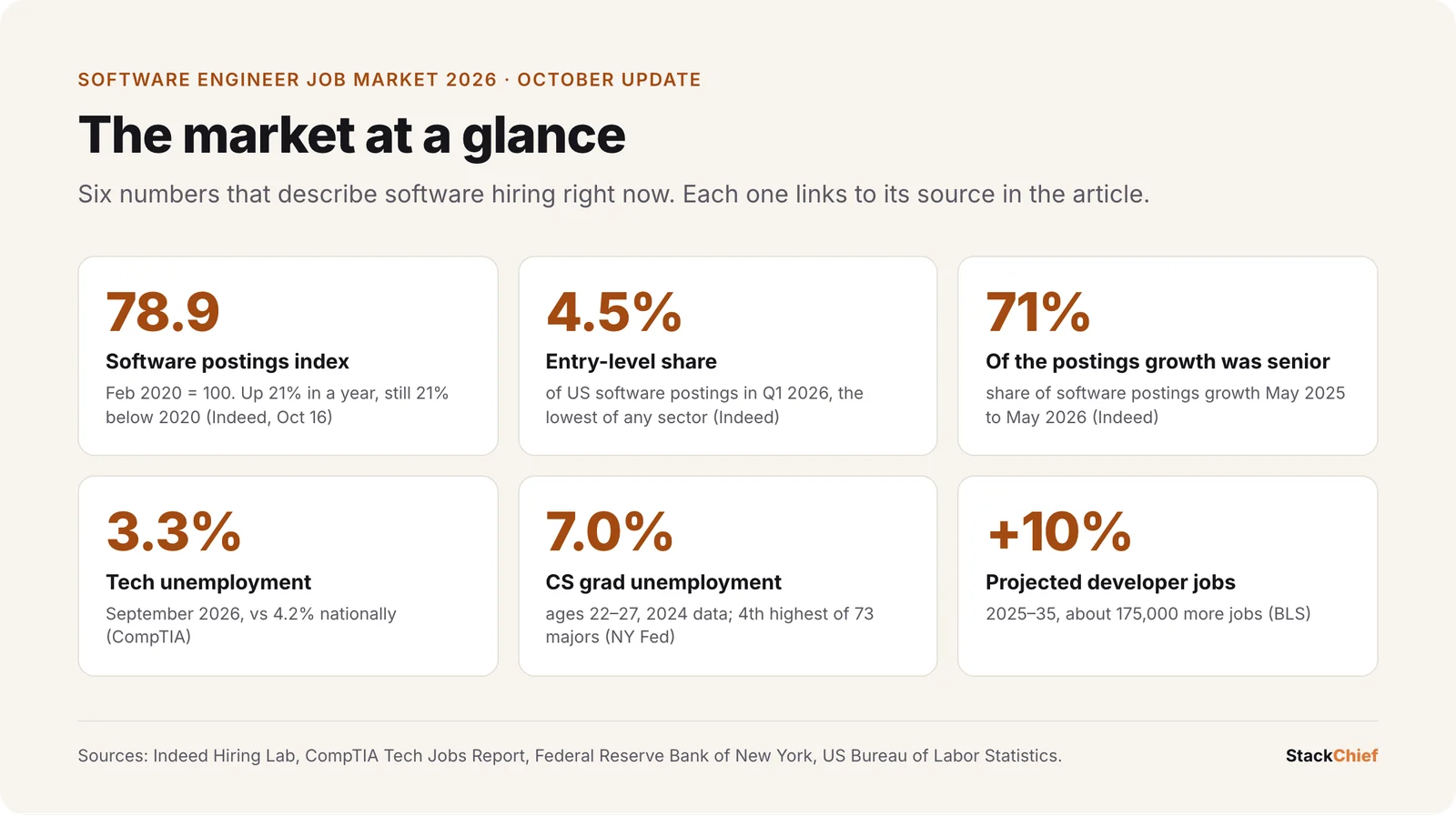
If you only have a minute, these six numbers describe the market. The rest of the article explains what's behind each one and what to do about it.
| Metric | Latest value | What it tells you | Source |
|---|---|---|---|
| Software development postings index (Feb 2020 = 100) | 78.9 (Oct 16, 2026) | Up 21% in a year, still 21% below 2020 | Indeed Hiring Lab data |
| Entry-level share of software postings | 4.5% (Q1 2026) | Lowest of any sector Indeed tracks | Indeed Hiring Lab |
| Share of postings growth from senior roles | 71% (May 2025 to May 2026) | The recovery favors experience | Indeed Hiring Lab |
| Tech unemployment rate | 3.3% (September 2026) | Below the 4.2% national rate | CompTIA |
| Unemployment, recent CS graduates | 7.0% (2024 data) | 4th highest of 73 majors | New York Fed |
| Projected software developer jobs, 2025–35 | +10% | Still much faster than average | BLS |
Put together, the picture is a market that is healing from the top down. People with experience are finding more openings than a year ago. People trying to get their first job are facing one of the hardest markets in years.
Is the Software Engineer Job Market Getting Better?
Yes, but from a very low base. Indeed publishes a daily index of job postings by sector, with February 2020 set to 100. On October 16, 2026, the software development index stood at 78.9. A year earlier it was 65.0, so postings are up about 21%. The low point was 61.1 in May 2025.
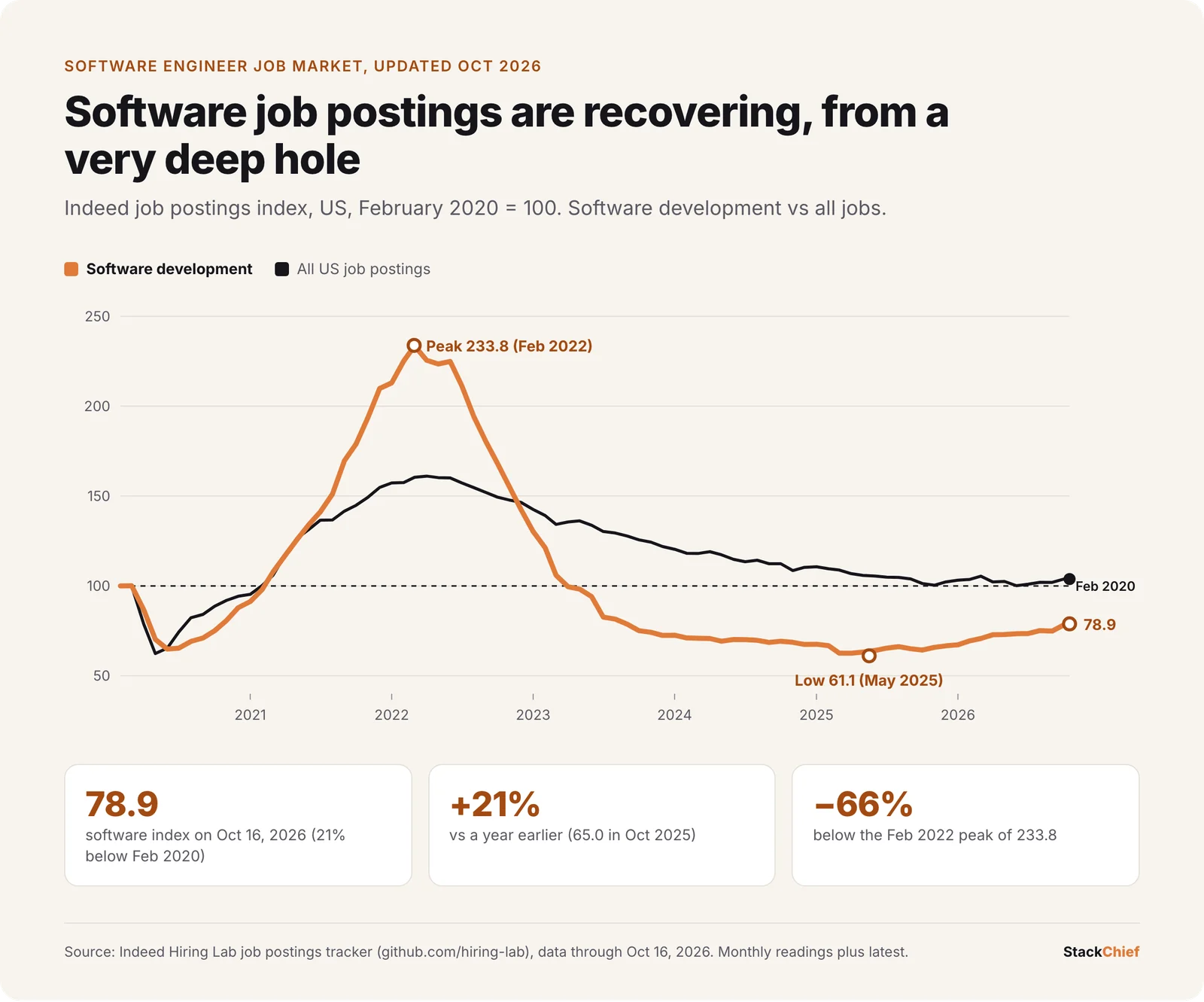
The chart explains why the market feels so different depending on when you entered it. Software postings more than doubled during 2021 and peaked at 233.8 in February 2022. They then fell for three straight years. Today's level is about 66% below that peak. If you got your first job in 2021, the market you remember no longer exists.
Compare that with the rest of the economy. All US job postings on Indeed are at 103.8, slightly above their pre-pandemic level, according to Hiring Lab's October 2026 snapshot. Software is one of the few large fields still well below 2020.
Software is still one of the weakest fields on Indeed
Indeed tracks 47 occupational sectors. On October 16, software development ranked 6th lowest. Only data and analytics, media and communications, IT infrastructure and operations, marketing, and IT systems were weaker. Meanwhile, mechanical engineering postings sit at 169 and electrical engineering at 152, both up more than 30% in a year.
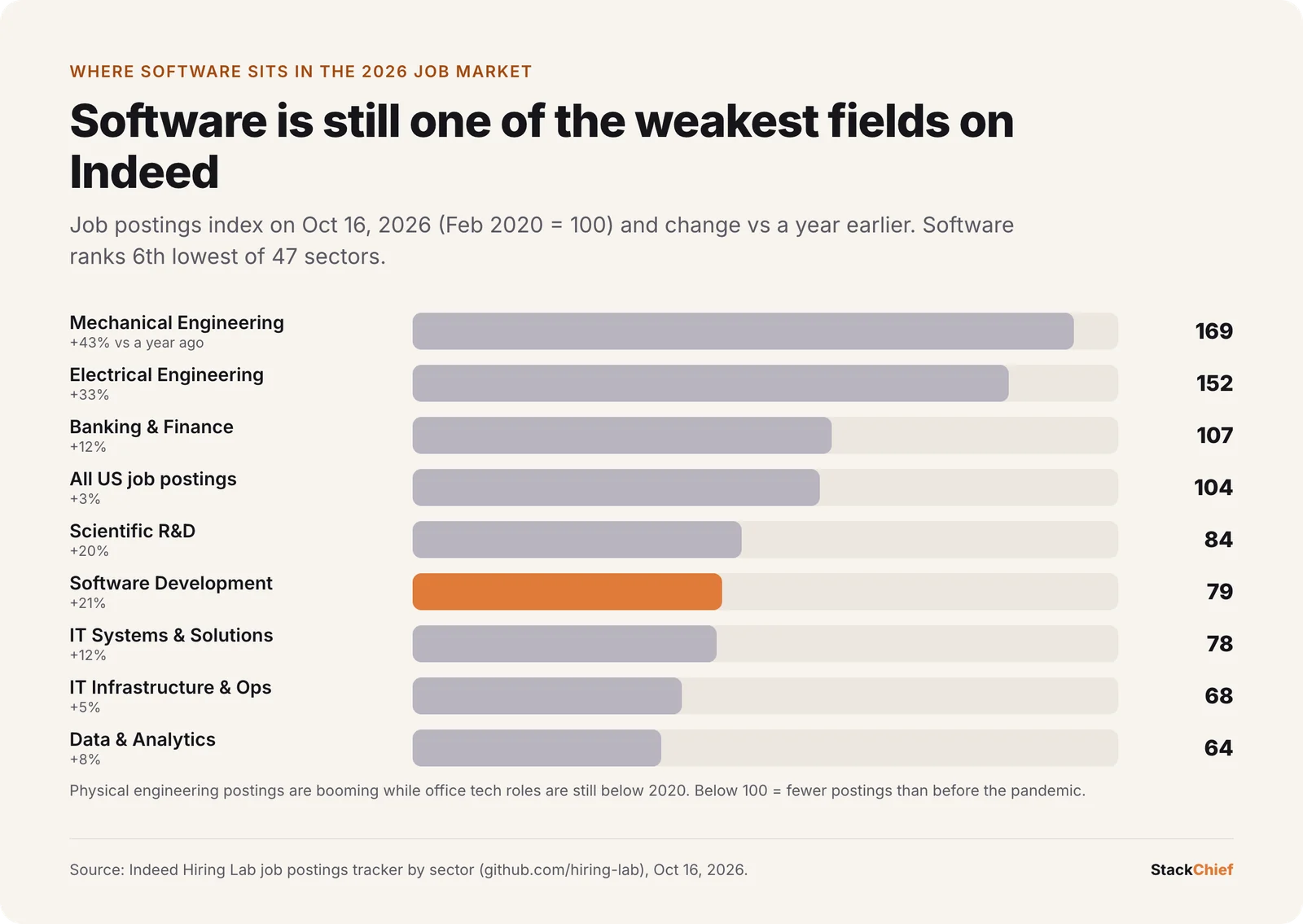
Two caveats keep this honest. First, an index measures change, not size: software is still a very large job category in absolute terms. Second, postings are not hires. One posting can be filled by an internal transfer, sit open for months, or never be filled at all.
A signal to watch: new postings slowed this summer
Indeed also publishes a "new postings" series, which counts ads posted in the past week. For software development, new postings averaged 82.8 in July through September 2026, down 6.6% from 88.6 in April through June, according to our calculation from Indeed's public data. Total postings kept rising over the same period. If new postings keep falling while total postings rise, more of the growth comes from ads staying open longer rather than from fresh openings. It's one month of divergence, not a trend yet, but it's the first number we'll check in the next update.
Who Is Getting Hired: Senior Engineers vs Entry-Level
The average hides a split. In Q1 2026, 69.3% of US software development postings on Indeed were for senior roles and just 4.5% were entry-level, the most senior-heavy mix of any sector, according to Indeed Hiring Lab. Across all US job postings, roughly 46% are entry-level.
The recovery has made the split wider, not narrower. Of the growth in software postings between May 2025 and May 2026, 71% came from senior roles, Indeed found in a July 2026 analysis. Employers are hiring people who can own systems and review AI-generated code on day one. They are hiring far fewer people they need to train.
Only about 1 in 22 software job postings is aimed at entry-level candidates. Across the whole US job market, it's nearly 1 in 2.
We covered why this is happening, and whether AI is the cause, in our data-driven look at whether AI will replace software engineers. The short version: payroll data shows hiring of young workers in AI-exposed jobs has slowed sharply, while employment of experienced workers has held up.
The new-grad paradox: high unemployment, top starting pay
The New York Fed's college labor market data shows the same split from the other side. Among recent graduates aged 22 to 27, computer engineering majors had a 7.8% unemployment rate and computer science majors 7.0% in the latest by-major figures (2024 data). Out of 73 majors, that ranks computer engineering 2nd and computer science 4th, just behind anthropology and fine arts.
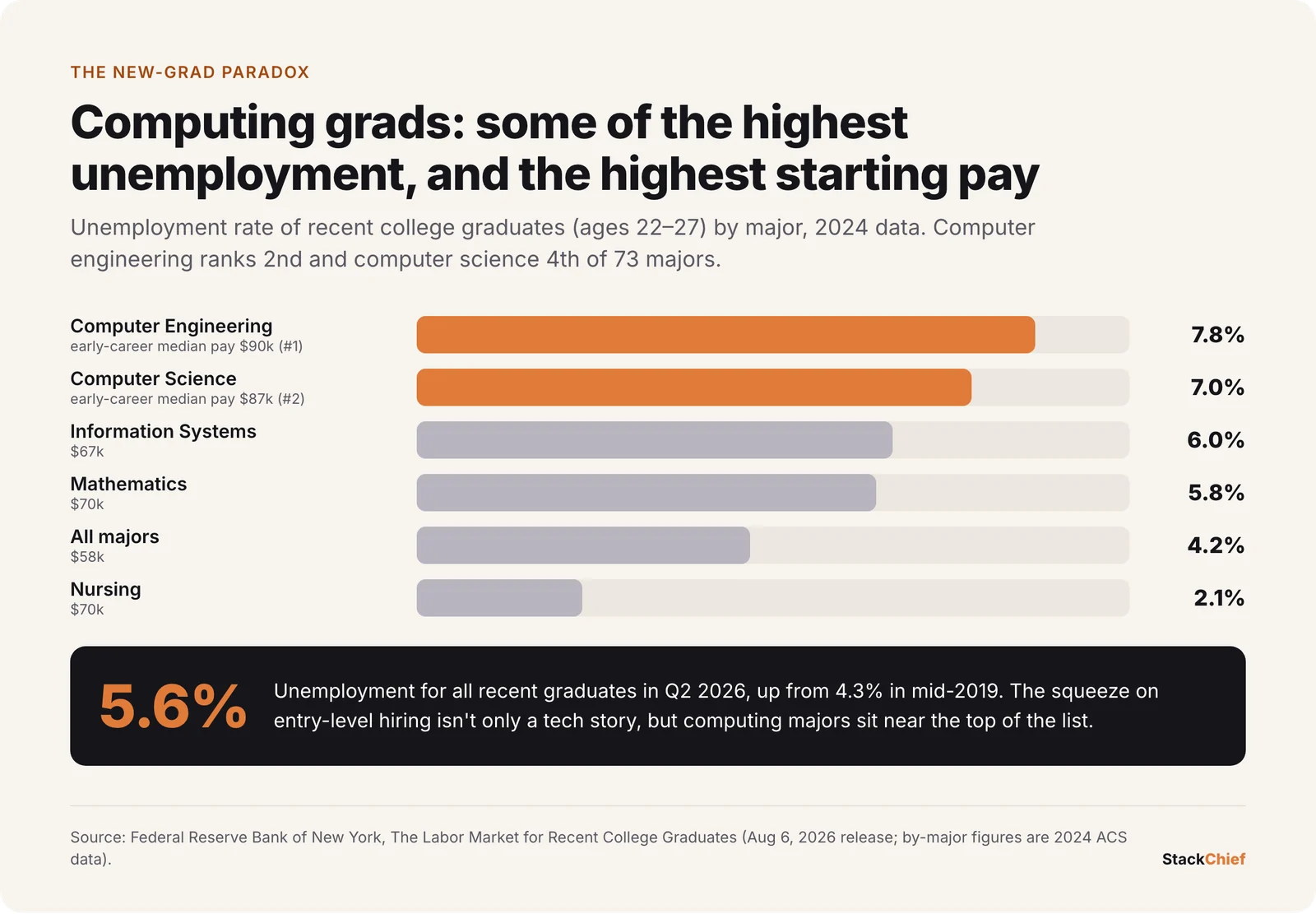
Yet the same majors top the pay table. Computer engineering graduates have the highest early-career median wage of any major ($90,000) and computer science the second highest ($87,000). That combination tells you the market isn't oversaturated in the usual sense. Graduates who get in are paid very well. The problem is getting in.
It isn't only a tech story. Unemployment for all recent college graduates was about 5.6% in the second quarter of 2026, up from about 4.3% in mid-2019, per the same New York Fed data. Entry-level hiring is weak across the economy. Computing majors just sit near the top of the list.
Which Software Engineering Jobs Are Growing in 2026
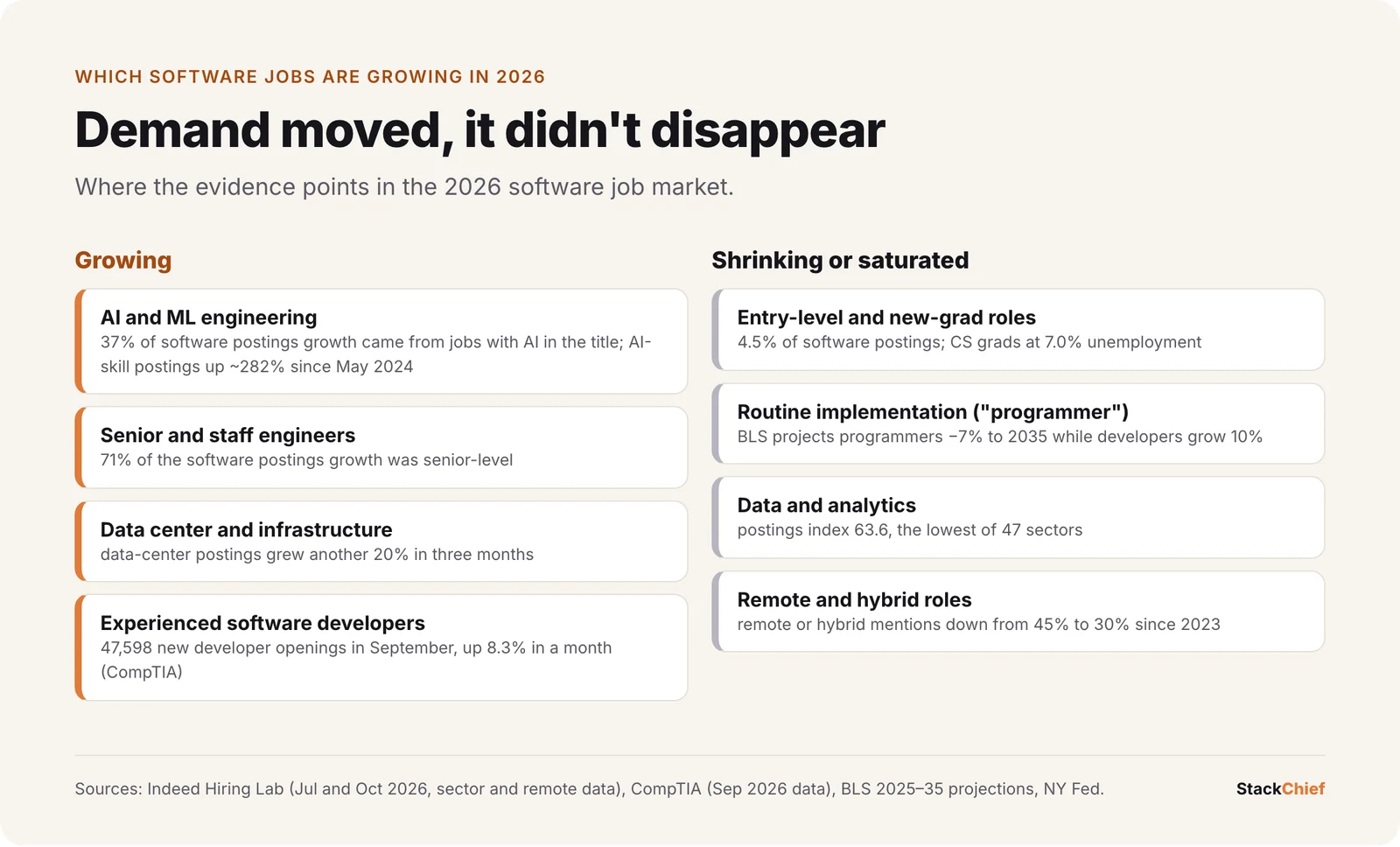
Demand has moved, not vanished. The clearest growth is in AI. Jobs with AI in the title accounted for 37% of the growth in software postings over the past year, according to Indeed. Across all US postings, AI-related jobs now make up 7.3% of ads, more than double their 2022 peak of 3.3%, per Hiring Lab's October snapshot.
| Area | Direction | Evidence |
|---|---|---|
| AI and machine learning engineering | Growing fast | 37% of software postings growth from AI-titled jobs (Indeed); AI-skill postings up about 282% since May 2024 (CompTIA) |
| Senior and staff engineers | Growing | 71% of software postings growth was senior-level (Indeed) |
| Data center and infrastructure | Growing | Data center postings grew another 20% in three months (Indeed) |
| General software developers | Recovering | 47,598 new developer openings in September, up 8.3% in a month (CompTIA) |
| Routine programming | Shrinking | BLS projects computer programmers to decline about 7% by 2035 while developers grow 10% |
| Data and analytics | Weakest sector | Postings index 63.6, the lowest of Indeed's 47 sectors |
| Entry-level roles | Scarce | 4.5% of software postings (Indeed) |
CompTIA's latest Tech Jobs Report backs this up with a different dataset. Active tech job postings reached 625,633 in September 2026, the highest total in more than three years and 22.4% more than a year earlier. Postings that ask for AI-related skills totaled 349,821. Employers posted 47,598 new openings for software developers and engineers in the month.
The skill that ties these growing areas together isn't a framework. It's judgment: deciding what to build, designing the system, and verifying output you didn't write by hand. If you want to move toward the AI side, our AI engineering section covers the practical skills employers list most often.
What AI Changed in Software Hiring
AI shows up in this market in three ways. It's creating new roles, as the posting data above shows. It's raising the bar for junior candidates, because work that used to train juniors can now be done by a senior engineer with a coding agent. And it's changing the interview itself.
Interview formats now differ sharply by company. Canva tells candidates it expects them to use AI tools in technical interviews and assesses how well they judge and fix the output. Meta has reportedly added an AI-assisted coding round that replaces one of its standard coding interviews. Anthropic's candidate guidance goes the other way: no AI assistance unless the interviewer says otherwise.
For candidates, this means two things. You need to be able to solve problems without help, because many rounds still ban AI. And you need to show you can direct and check an AI assistant, because a growing number of rounds expect it. Our interview prep hub collects our guides to both formats, and the interview checklist is a printable version of what to prepare.
Layoffs vs Hiring: Both Are Up in 2026
Here's the part that confuses people: layoffs and job postings are rising at the same time. Layoffs.fyi counted 135,183 tech employees laid off at 331 companies in 2026 as of October 22, already more than its total for all of 2025 (122,606). That's still about half of the 2023 peak.
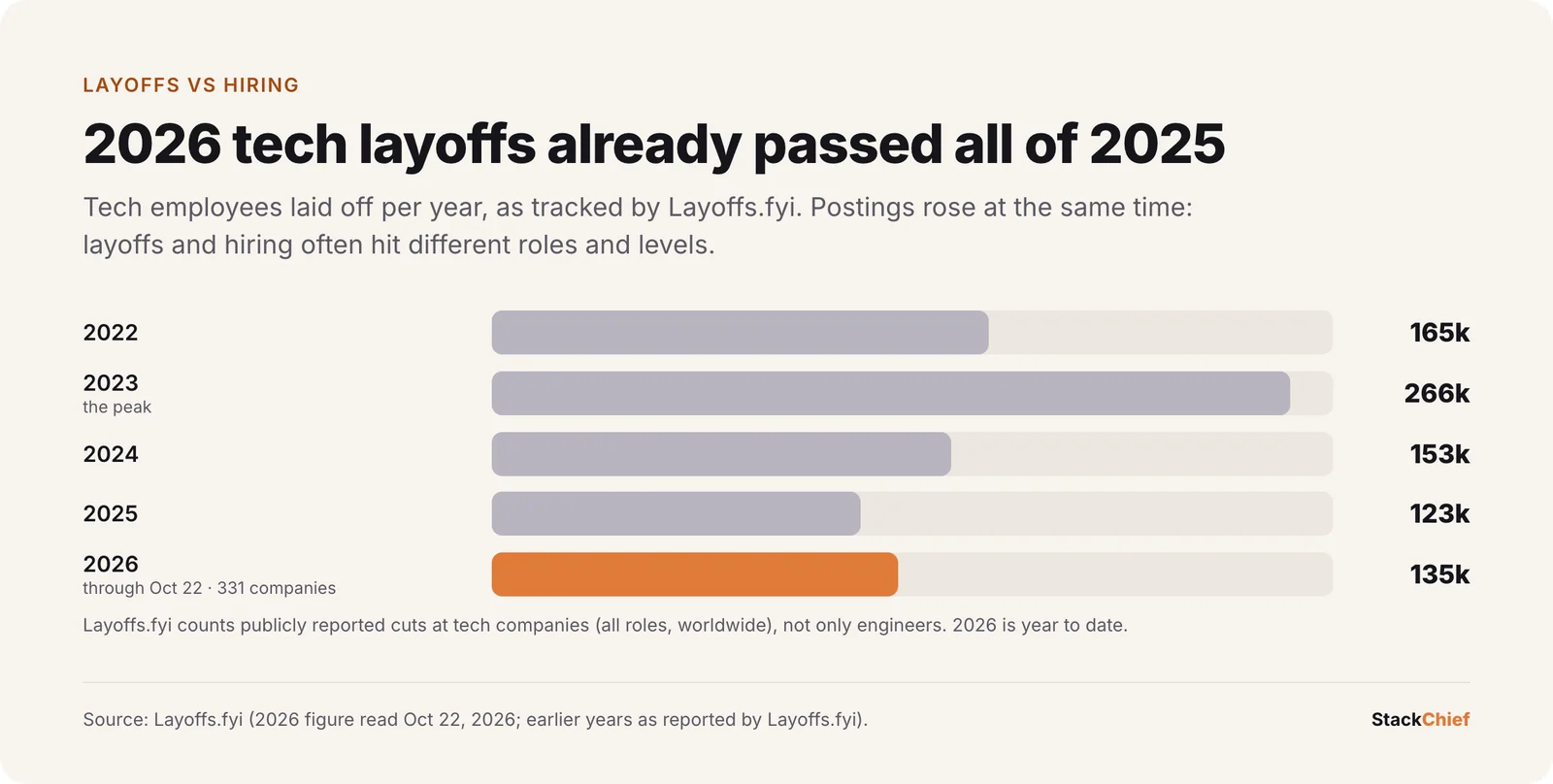
Both trends can be true because they often hit different people. Layoffs.fyi counts all roles at tech companies, including recruiting, sales and support, not only engineers. Postings growth, meanwhile, is concentrated in senior and AI-focused engineering roles.
The official numbers reflect the churn. CompTIA estimated that tech sector employment fell by about 10,350 jobs in September, even as postings hit a three-year high. Tech unemployment rose to 3.3% from 3.1% in August, still well under the 4.2% national rate. For an individual engineer, the takeaway is practical: a layoff in 2026 is a setback, not a verdict on your career, and the market for experienced people is more active than the layoff headlines suggest.
Remote Work and Location in the 2026 Job Market
If you're holding out for a fully remote job, the odds are getting worse. The share of US software development postings on Indeed that mention remote or hybrid work peaked at 45.2% in May 2023. By the end of September 2026 it was 30.4%, according to Indeed's remote work tracker. That's still four times the pre-pandemic level, but insurance and legal postings now mention remote work more often than software does.
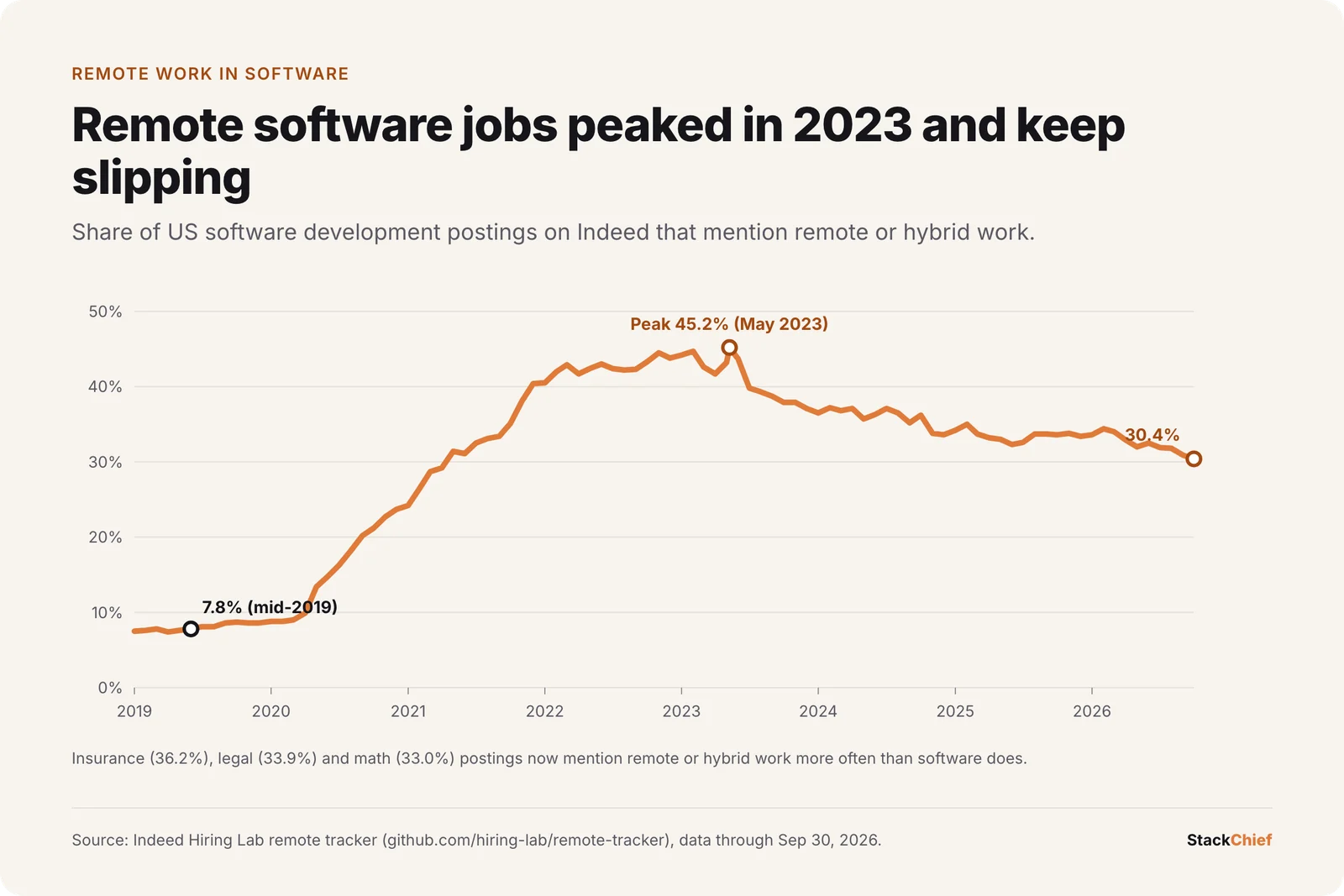
Location matters again too. The traditional tech hubs have some of the weakest local job markets in the country: Indeed's overall postings index for Seattle is 67 and San Francisco 72, among the lowest of any metro, per the October snapshot. Those numbers cover all jobs, not only software, but they reflect how much those economies depend on tech hiring.
Internationally, the US is one of the stronger markets. The Pragmatic Engineer's 2026 job market analysis found software engineering vacancies rose over the past year in the US and UK, while they fell in Germany and France. For more on how flexible arrangements are changing, see our look at the future of remote work.
Software Engineer Salaries in 2026
Pay has held up better than hiring. The median annual wage for software developers was $135,980 in May 2025, according to the BLS Occupational Outlook Handbook, more than 2.5 times the median for all workers ($50,980). Early-career pay for computing graduates remains the highest of any major, as the New York Fed data above shows.
The long-term outlook is also positive on paper. BLS projects software developer employment to grow about 10% from 2025 to 2035, much faster than the average for all occupations, while narrow "computer programmer" roles are projected to shrink. That forecast was cut from the previous cycle's 15.8%, which is a fair summary of the decade ahead: growth, but less of it, and in different kinds of jobs. Our answer to what counts as a good software engineer salary has more on how pay varies by level.
How to Get a Software Engineering Job in This Market
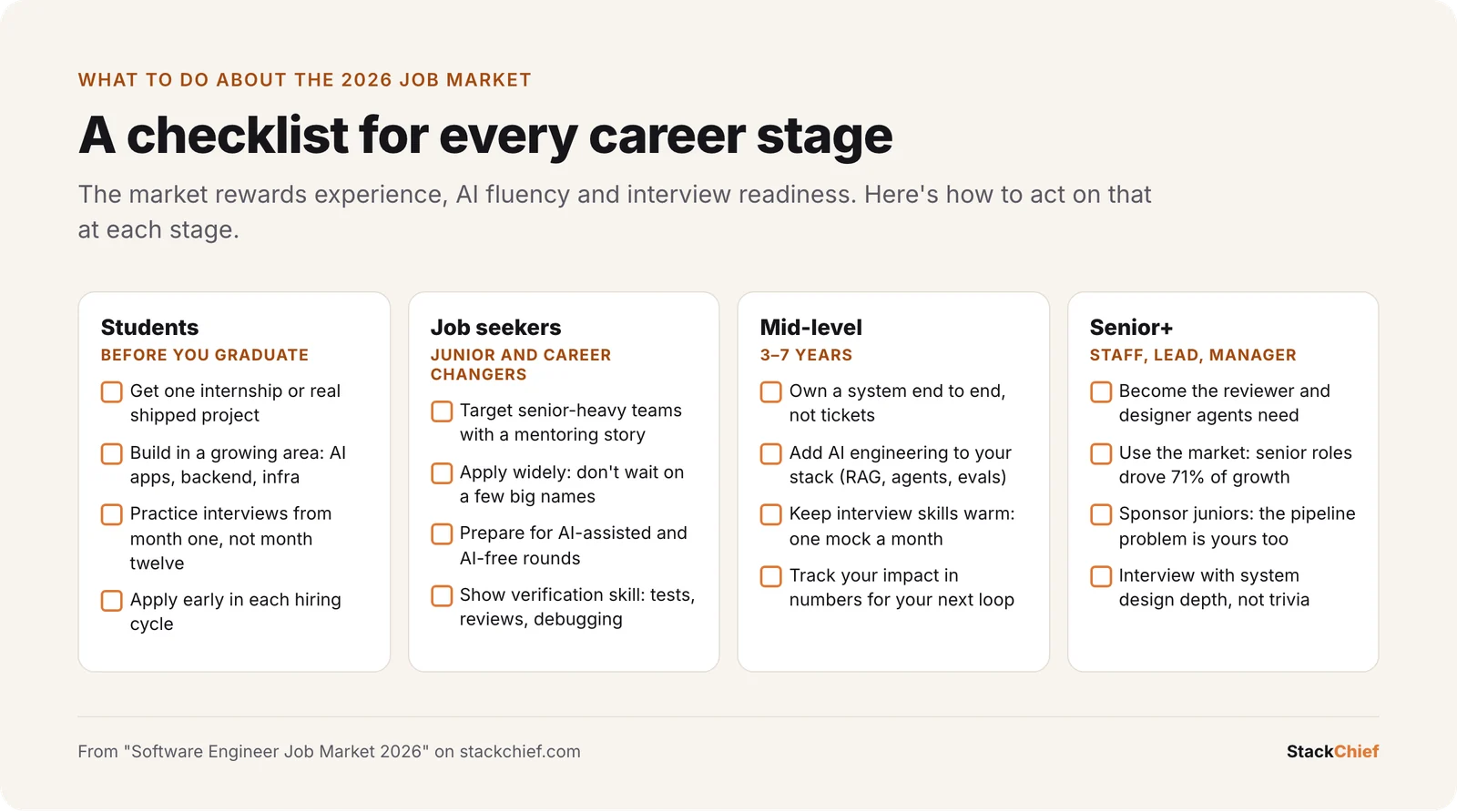
The data points to the same three advantages again and again: experience, AI fluency, and interview readiness. You can't change your years of experience overnight, but you can change the other two. Here is what that looks like at each career stage.
Students and new graduates
- Get one internship or one real shipped project with users. With only 4.5% of postings at entry level, proof of shipped work is what separates applications.
- Build in a growing area: an AI application, a backend service, or infrastructure work.
- Start interview practice early. Data structures, algorithms and system design basics take months, not weeks.
- Apply early in each hiring cycle, and apply widely rather than waiting on a few well-known companies.
Junior engineers and career changers
- Target teams that are mostly senior and can explain how they mentor. Those teams are the ones posting.
- Show that you can verify code: tests, careful reviews, and debugging stories carry more weight when AI writes the first draft.
- Prepare for both AI-assisted and AI-free interview rounds, and ask the recruiter which one you'll get.
Mid-level engineers
- Own a system end to end, not only tickets. Senior roles are where the openings are, and ownership is what gets you there.
- Add AI engineering to your toolkit: retrieval, agents, evaluation, and prompt and context design.
- Keep interview skills warm with a mock interview every month, so a layoff or a recruiter message doesn't catch you cold.
Senior engineers and managers
- Use your position: senior roles drove 71% of the postings growth, so you have more bargaining power than headlines suggest.
- Become the person who designs the system and reviews what agents produce. That work is growing, not shrinking.
- Prepare system design and behavioral stories with real numbers. At senior levels, those rounds decide the offer.
Notice what every list has in common: the interview. When entry-level openings are rare and senior roles are contested, the interview is where offers are won or lost. Plenty of strong engineers miss offers because they prepared for the job and not for the interview. If that's where you want to focus, our book Mastering the Tech Interview is a short, practical guide to preparing for technical and behavioral rounds, written for exactly this kind of market. For a quick win before your next loop, read our tech interview tips no one talks about.
How We Track the Software Engineer Job Market
We use primary sources only, and we say when a number comes from a company with something to sell. The core datasets are Indeed Hiring Lab's public job postings and remote work data, CompTIA's monthly Tech Jobs Report (which analyzes BLS data and job postings), the New York Fed's recent-graduate data, BLS projections and wages, and the Layoffs.fyi tracker. The charts on this page are drawn from the raw data files, not screenshots of other people's charts.
Each source has limits. Indeed postings are ads, not hires, and they don't capture referrals or roles filled without a public posting. Layoffs.fyi counts publicly reported cuts and covers all roles, not just engineers. The New York Fed's by-major figures lag by about a year. We refresh this page monthly, update the charts, and note what changed at the top of the page.
FAQ
Is the software engineer job market getting better in 2026?
Yes, slowly. Indeed's software development postings index is up about 21% from a year ago and well off its May 2025 low, and CompTIA reports tech postings at a three-year high. But postings are still about 21% below February 2020, and the improvement is concentrated in senior and AI-related roles.
Is the tech job market bad right now?
It depends on your level. For experienced engineers, especially with AI or infrastructure skills, the market is noticeably better than in 2024 and 2025. For new graduates it's still very hard: only 4.5% of software postings are entry-level, and recent computer science graduates have a 7.0% unemployment rate.
Is software engineering oversaturated?
Not in the usual sense. Computing graduates still earn the highest starting pay of any major, and tech unemployment (3.3%) is below the national rate. The squeeze is at the entry point: there are far more junior candidates than junior openings, while senior roles drove most of the recent growth.
Are software engineers still in demand?
Yes. BLS projects software developer jobs to grow about 10% from 2025 to 2035, much faster than average, and employers posted 47,598 new software developer openings in September 2026 alone. Demand has shifted toward senior engineers and AI-related work rather than disappearing.
Why is it so hard to get a junior developer job?
Employers are hiring for experience. In Q1 2026, 69.3% of software postings were senior-level and 4.5% entry-level, and AI tools let senior engineers handle more of the routine work that used to go to juniors. Shipped projects, internships, and strong interview preparation are the most reliable ways through.
Will AI replace software engineers?
The evidence so far says AI is changing the job rather than eliminating it: developer jobs are still projected to grow, and AI-titled roles drove more than a third of recent postings growth. We cover the data in depth in our article on whether AI will replace software engineers.
Further Reading
- Indeed Hiring Lab: US Labor Market Snapshot, October 2026 — the latest overall and sector postings data.
- Indeed Hiring Lab: The labor market is tilting toward seniority — the entry-level vs senior split by sector.
- CompTIA Tech Jobs Report, September 2026 data — tech unemployment, postings, and AI skills demand.
- Federal Reserve Bank of New York: The Labor Market for Recent College Graduates — unemployment and pay by major.
- BLS Occupational Outlook Handbook: Software Developers — pay and 2025–35 projections.
- The Pragmatic Engineer: State of the software engineering job market in 2026 — company-level hiring trends.
