
Key Takeaways
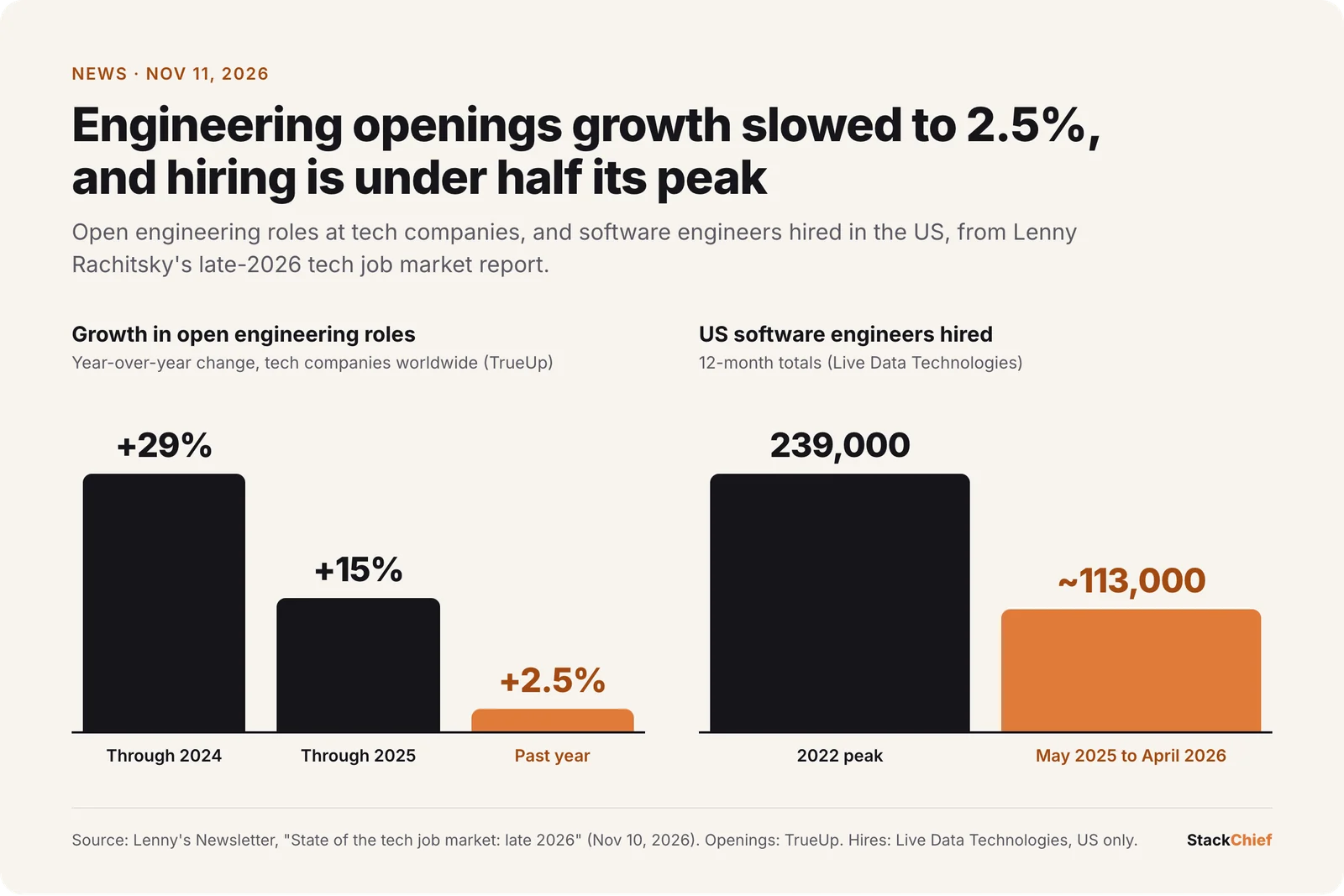
- Lenny Rachitsky's "State of the tech job market: late 2026," published November 10, 2026, reports that open engineering roles at tech companies grew just 2.5% over the past year, after 29% growth through 2024 and 15% through 2025.
- US companies hired about 113,000 software engineers from May 2025 to April 2026, according to the report's Live Data Technologies figures. That is less than half the 2022 peak of 239,000.
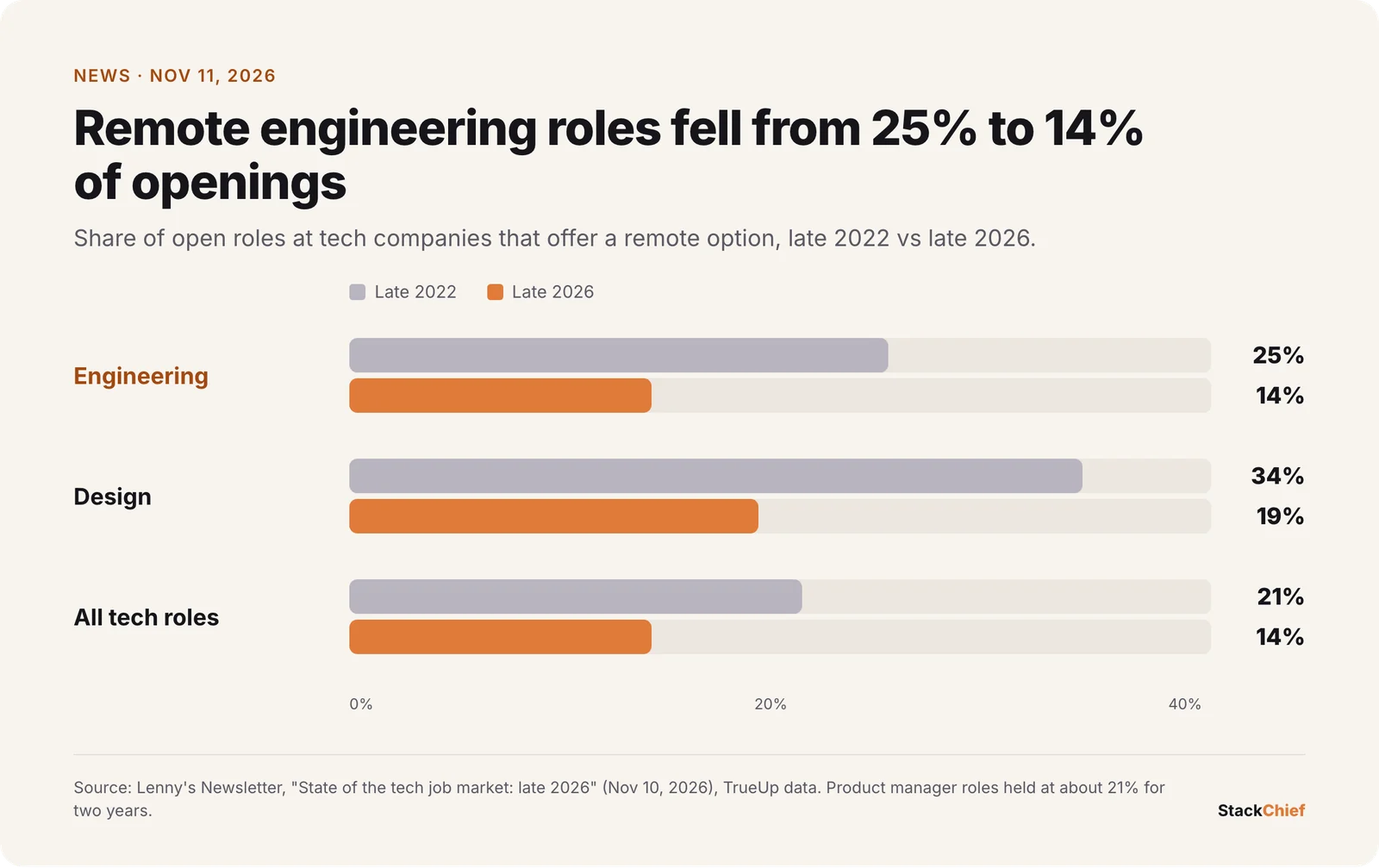
- Only 14% of open engineering roles at tech companies offered a remote option in late 2026, down from 25% in late 2022. One in five open engineering roles is now in the Bay Area.
- "LLM" just passed Java as a skill named in engineering job postings, and forward deployed engineer openings rose 4.6x in a year to around 1,500.
- Other demand measures disagree on direction. Indeed's software postings index was up 21.3% year over year in mid-October 2026, while BLS employment at computer systems design firms was down 1.1%. The table below shows why.
The tech job market late 2026 report from Lenny Rachitsky, out November 10, paints a different picture for engineers than the spring edition did. It says demand for engineers at tech companies has stalled, remote roles have hit a record low and hiring is running at less than half its 2022 level. This post sets the report's engineering numbers next to the Indeed, BLS and CompTIA series we track, and turns the gaps into a plan for your search.
What happened
On November 10, 2026, Lenny Rachitsky published "State of the tech job market: late 2026", his fifth twice-yearly look at tech hiring. It draws on two datasets: TrueUp, which tracks openings at more than 9,000 tech companies worldwide, and Live Data Technologies, which tracks hires and job moves for 124 million professionals and supplies the US hiring counts. The subtitle sums it up: "PMs are winning, engineers are plateauing, designers are hurting, and the biggest AI hiring boom isn't in software."
For engineers, the main line is short: "Open engineering roles grew 29% through 2024, 15% through 2025, and just 2.5% this past year." The report adds that there are "fewer open eng roles at tech companies today than there were even this past March."
The details that matter to engineers
Openings stalled while hiring fell
The report counts more than 65,000 open engineering roles at tech companies today. That is a large number, but it has barely moved in a year. Hiring tells a harsher story. "Companies in the U.S. hired about 113,000 software engineers over the past 12 months," the report says, "less than half the 2022 peak (239,000)." By our arithmetic, that is 126,000 fewer hires, a 52.7% drop. Over a slightly different window, calendar 2025, the report counts "over 120,000" US engineering hires.
The two series have moved apart: "engineering job openings are up while actual hiring is down (+44% vs. −17% since January 2024)." Rachitsky also notes that open recruiter roles are up nearly 300% since mid-2023, which he reads as a possible early sign that hiring will pick up. That is his reading, not a forecast in the data.
Which engineering roles are growing
- Forward deployed engineers. FDE openings are up 4.6x in the past year, to around 1,500. Historically there were "only a few dozen open FDE roles globally," mostly at Palantir. Rachitsky says some of the growth may be sales-engineer roles that were renamed.
- Security engineering is among the fastest-growing specialties, behind FDE.
- Mobile and front-end demand has nearly halved in the past year. The report connects this to specialized disciplines folding into broader ownership, with AI tools helping.
- Skills. Python is still the most-named engineering skill and is growing. "LLM" just passed Java in engineering postings, Java is declining, and Kubernetes is holding up.
Four ways to measure engineering demand, side by side
The report's numbers can look like they contradict the other series we track. Mostly they measure different things. The table sets the latest reading of each against its own comparison point.
| Measure | Source | What it covers | Latest reading | Change |
|---|---|---|---|---|
| Open engineering roles | TrueUp, via Lenny's Newsletter | Openings at 9,000+ tech companies, worldwide | Over 65,000 (Nov 2026) | +2.5% over the past year |
| Software engineers hired | Live Data Technologies, via Lenny's Newsletter | Actual US hires, all employers | About 113,000 (May 2025 to April 2026) | −52.7% vs the 2022 peak of 239,000 |
| Software development postings index | Indeed Hiring Lab, via FRED | Postings on Indeed, all US employers | 81.4 on Nov 6, 2026 (Feb 2020 = 100) | +21.3% year over year (Oct 16) |
| New software developer postings | CompTIA (Lightcast) | New US postings in the month | 51,944 (Oct 2026) | +6.3% vs September |
| Employment, computer systems design and related services | BLS | US headcount in one industry, all occupations | 2,354,100 (Oct 2026, preliminary) | −1.1% year over year |
Change figures for hires are our calculation from the report. Postings counts and openings counts are not hires, and the BLS line counts everyone at software services firms, not just engineers.
The numbers behind the tech job market late 2026 report
Put together, the measures agree on one point: the number of openings is a poor guide to how many engineers actually get hired. Indeed's index has climbed from a low of 61.1 in May 2025, and CompTIA counted 290,892 new IT postings in October, up 22.2% from a year earlier. Yet the hiring count from Live Data Technologies is down, and BLS shows software services firms employing fewer people than a year ago.
The TrueUp figure is narrower than Indeed's. It covers tech companies only, while Indeed's rebound includes engineering jobs at banks, retailers and health systems. That is consistent with the report's own Takeaway 7 heading, "Overall, the tech job market is growing—but outside of software roles," though the detail behind that heading is paywalled and we don't use it here.
Remote is shrinking, and the Bay Area is growing
"Remote engineering roles are also at record lows, currently at 14%, and down from the 25% we saw in late 2022," the report says. Across all tech roles the remote share is 14%, down from 21%. Meanwhile 15% of all open roles at tech companies are in the Bay Area, the number of Bay Area openings is up 43% from a year ago, and "one in five engineering roles" is there. By the report's count, there are now more open engineering, PM and design roles based in the Bay Area than remote roles worldwide.
Indeed's remote tracker shows a softer picture: 30.4% of US software postings mentioned remote or hybrid work on September 30, 2026, down from a peak of 45.2% in May 2023. The difference is in the definition. Indeed counts hybrid mentions and all employers; TrueUp's 14% is a remote option at tech companies. Both are falling.
What the data can't tell you
The report doesn't say why engineering demand stalled, and we don't either. TrueUp counts openings, which can stay posted after a role is filled or frozen. Live Data Technologies builds its hiring counts from public profiles, so they depend on people updating them. The headline hires figure ends in April 2026, so it doesn't capture the past six months.
What this means for you
If you're job hunting
- Don't size your search by the openings count. Openings are up 44% since January 2024 and hires are down 17%. Expect more applications per hire and a longer process than job-board totals suggest.
- Decide on location before you start. With 14% of engineering openings at tech companies offering remote work and one in five based in the Bay Area, a remote-only search covers a small slice. Know whether you'd take hybrid or relocate.
- Look outside tech companies. The Indeed rebound includes non-tech employers, and the report's paywalled last takeaway points the same way.
- If you're early in your career, Indeed found entry-level roles were 4.5% of software postings in Q1 2026. Expect the gap between openings and hires to be widest for you.
If you're employed and watching the market
- Show LLM work, not just LLM interest. "LLM" passing Java in postings means employers screen for it. A shipped feature, an eval harness or a retrieval pipeline is easier to defend in an interview than a course certificate.
- Specialists in shrinking niches should broaden. If you're a mobile or front-end specialist, add backend or full-stack ownership. Security and customer-facing FDE work are the growing directions in this data.
How this connects
Our software engineer job market 2026 hub tracks the Indeed, BLS and CompTIA series every month. This report adds two things the hub didn't have: a count of actual hires, and the remote share at tech companies. Last week's October 2026 jobs report showed the same gap between openings and headcount from the government side. For the AI question behind all of this, see what the 2026 data says about AI replacing software engineers. Remote and Bay Area pay differences are in our software engineer salary 2026 guide.
When hires fall while openings hold, each interview loop counts for more. If yours is coming up, Mastering the Tech Interview covers the coding, system design and behavioral rounds, and our AI engineer interview questions cover the LLM skills employers now list.
FAQ
Is the tech job market getting better in late 2026?
For engineers at tech companies, not much. Lenny Rachitsky's November 10, 2026 report found open engineering roles grew 2.5% over the past year, down from 15% through 2025 and 29% through 2024, with fewer open roles than in March. Postings across all employers on Indeed were up 21.3% year over year in mid-October.
How many software engineers were hired in 2026?
The report counts about 113,000 software engineers hired in the US from May 2025 to April 2026, based on Live Data Technologies data. That is less than half the 2022 peak of 239,000. For calendar 2025, it counts over 120,000 US engineering hires.
What percentage of software engineering jobs are remote in 2026?
About 14% of open engineering roles at tech companies offered a remote option in late 2026, down from 25% in late 2022, according to TrueUp data in the report. Indeed's broader measure, which includes hybrid and all employers, was 30.4% of US software postings on September 30, 2026.
What skills are in demand for software engineers in late 2026?
Python remains the most-named skill in engineering postings, and "LLM" just passed Java, which is declining. Forward deployed engineer openings rose 4.6x in a year and security engineering is among the fastest-growing specialties, while demand for mobile and front-end engineers nearly halved.
Further Reading
- Lenny Rachitsky, "State of the tech job market: late 2026": the full report (Takeaways 1–6 free).
- FRED, Software Development Job Postings on Indeed: the daily postings index, February 2020 = 100.
- Indeed Hiring Lab, "The Labor Market Is Tilting Toward Seniority": senior and entry-level shares of software postings.
- Indeed Hiring Lab remote tracker: remote and hybrid shares of postings by sector.
- BLS, The Employment Situation — October 2026: industry employment, including computer systems design.
- CompTIA, "Tech employment gains momentum in October": IT postings and software developer postings.
