
Key Takeaways
- On November 4, 2026 (Sydney time), Canva CEO Melanie Perkins told staff that a restructure will affect 1,271 roles, about 22% of the company, through job cuts, changed roles or relocation.
- Canva is merging its Product, Growth and Platform teams into one product organization, cutting management layers, making Sydney the primary home for product teams, and expecting most hybrid staff in the office two to three days a week from January 2027.
- Canva is one of five tech companies that announced cuts between November 2 and 4, 2026, alongside Squarespace (about 19%, mostly product and engineering), SUSE (about 10%), NICE (500 people) and Fiserv (3,000 roles since June).
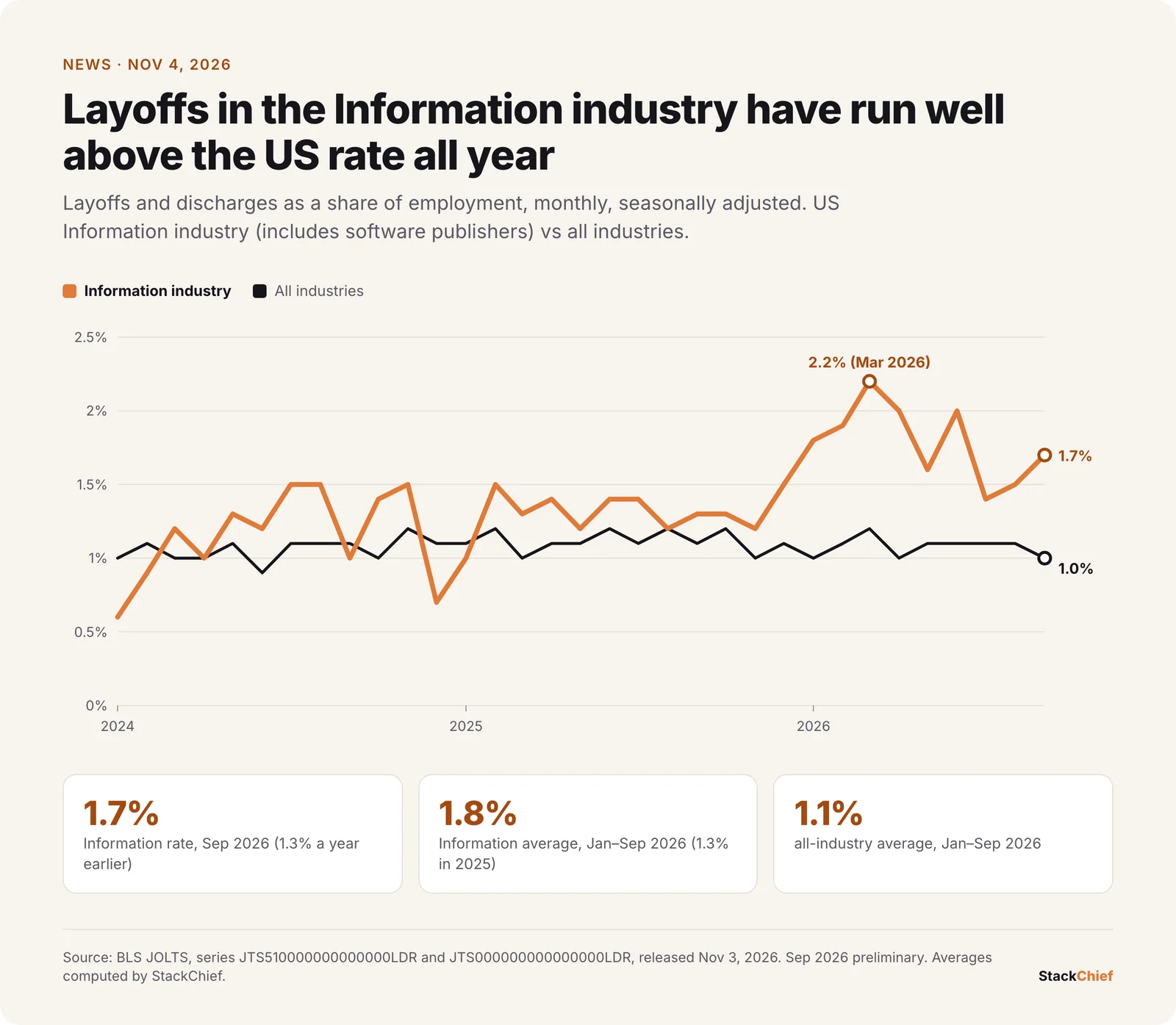
- BLS data released November 3, 2026 put the US Information industry's layoffs rate at 1.7% in September. Its January–September 2026 average is 1.8%, against 1.3% for the same months of 2025 and 1.1% for all industries in 2026.
- Canva's memo doesn't cite AI as a reason. Departing staff get at least six months' salary, and an all-hands is set for November 10.
The Canva layoffs 2026 announcement is what CEO Melanie Perkins called the hardest moment in the company's 13-year history: 1,271 roles, about 22% of a workforce of more than 5,700, are being cut, changed or moved. For engineers, the bigger news may be the shape of the new company. Product, growth and platform engineering become one organization, more of it sits in Sydney, and the remote-first era at Canva ends in January.
What happened
In a memo titled "An important update on our team," Perkins said Canva would change how it is organized, where some teams are based, and which roles and skills it needs. She called it the "hardest moment in our 13-year history," the ABC reported, and said growth had slowed "for the first time in a decade."
The 1,271 figure covers three outcomes: people who lose their jobs, people whose roles change, and people asked to relocate to a hub. The coverage so far gives no separate count of job losses. Read "22%" as the share of the company affected, not the share laid off.
Canva layoffs 2026: the details that matter to engineers
One product organization instead of three
Canva will bring its Product, Growth and Platform teams together into a single product organization, and remove management layers, as Dealroom summarized the memo. Perkins framed it as a return to "small, empowered teams." In engineering terms, that usually means platform engineers sitting closer to product work, fewer managers per engineer, and fewer handoffs between teams.
Sydney first, and back to the office
Sydney becomes "the primary home for Canva's product teams," the ABC reported, and some staff will be asked to move. From January 2027, most hybrid employees are expected in the office around two to three days a week. People Matters describes this as a reversal of Canva's earlier remote-first approach. For an engineer outside Australia, that changes which Canva roles will exist next year, not only who is leaving this week.
What departing staff get
Per People Matters, people who leave receive at least six months' salary (including statutory entitlements), 12 months of healthcare where Canva already provides it, career coaching, interview prep and their company MacBook. The one-year vesting cliff is removed for people who joined in the past year. A new Canva Collective Fund offers US$10,000 grants, with no equity taken, to people who want to start something of their own.
What the memo says about AI
Nothing, as a reason. The ABC notes that Canva "did not explicitly mention" AI and spoke of "new technology" changing how people create. The backdrop is a growth slowdown: Canva lowered its 2026 revenue growth forecast from 30% to 20% in August, according to People Matters, while competing with AI image tools from OpenAI and Google. Some outlets have labeled this an "AI restructure." The memo doesn't support that label.
The week's tech cuts, side by side
Canva wasn't alone. Between November 2 and 4, 2026, five tech companies announced cuts or reported them on earnings calls. We put them in one table, because single-company coverage hides the pattern: smaller teams, fewer layers, and companies split on whether to name AI.
| Company | Announced | Size | Share of workforce | Teams named | What it said about AI |
|---|---|---|---|---|---|
| Canva | Nov 4 | 1,271 roles affected (cut, changed or moved) | about 22% | Product, Growth and Platform merge | Not cited as a reason |
| Squarespace | Nov 2 | about 300 jobs | about 19% | Mostly product and engineering | Denies a link to AI infrastructure spending |
| SUSE | Nov 2 | not disclosed | about 10% | Not named | Cited: "automation and AI" |
| NICE | Nov 3 | 500 jobs | about 5% | Not named | Reorganizing around customers "deploying CX AI" |
| Fiserv | Nov 3 | 3,000 employee and contractor roles since June | not given (over 38,000 staff) | Senior management down more than 10% | Using AI in software development (PYMNTS) |
Two of the five name engineering directly. Squarespace's cuts fell mostly on product and engineering, and CEO Anthony Casalena wrote that "the way we need to work is changing faster than at any point in our history." SUSE's CEO, Dirk-Peter van Leeuwen, went furthest: "The requirement for some existing roles has greatly diminished." Fiserv is the only one tying AI to how it builds software, and that comes from PYMNTS coverage of its earnings call, not from a quoted statement.
The common thread is structure, not a single cause. Canva wants "small, empowered teams." Squarespace wants "smaller teams, more player coaches." Fiserv cut senior management by more than 10%. Fewer layers means fewer manager roles and more senior engineers expected to lead without the title.
The numbers behind it
The official US data shows the same pressure on the industry that includes software publishers. In the September 2026 JOLTS report, released November 3, the layoffs and discharges rate across all industries was 1.0%, and openings were 7.5 million. In the Information industry, Table 5 shows 46,000 layoffs and a rate of 1.7%, up from 1.3% a year earlier.
| Layoffs and discharges rate, Jan–Sep average | 2024 | 2025 | 2026 |
|---|---|---|---|
| Information industry | 1.1% | 1.3% | 1.8% |
| All industries | 1.0% | 1.1% | 1.1% |
We averaged the monthly BLS series for the first nine months of each year. Information's rate has run about 1.7 times the all-industry rate in 2026. Every month this year it was 1.4% or higher, while all industries never went above 1.2%. March 2026, at 2.2%, is the highest Information reading since at least January 2024.
Two caveats. "Information" is broader than software: it includes telecom, broadcasting and data hosting, and many software engineers work in professional and business services instead. And JOLTS is US-only, so Canva's Australian-headquartered cut won't show up in it. The series still tells you something useful: layoffs in this corner of the economy have run well above the national rate all year, while openings in the industry (116,000 in September) were close to a year earlier.
What this means for you
If you work at Canva
- Wait for the November 10 all-hands before deciding on relocation. Ask which outcome (cut, changed role or move) applies to you, in writing.
- If you joined in the past year, check how the removed vesting cliff applies to your grant.
- Start interview prep now, even if your role survives. A merged product organization with fewer layers will re-level some people.
If you're job hunting
- Check the office policy before you apply. Canva's product roles are concentrating in Sydney with two to three office days, so a "remote" listing from before this week may not mean the same thing in January.
- Expect more competition for product and platform roles. Squarespace's cuts fell mostly on product and engineering, and Canva's merge is in the same functions.
- Prepare for AI in the interview itself. Canva already expects backend, machine learning and frontend candidates "to use AI tools like Copilot, Cursor, and Claude during our technical interviews."
If you're a senior engineer anywhere
- Fewer layers means more scope per person. Write down what you own across product and platform, because in a merged organization that's what gets evaluated.
- Keep a current resume and one recent mock interview, so a restructure memo doesn't start your job search from zero.
How this connects
Our software engineer job market 2026 data hub shows layoffs and job postings rising at the same time this year. This week fits that: five companies cut, while US openings held at 7.5 million. Last week's Microsoft voluntary buyout was a different tool, voluntary exits, aimed at the same goal: a flatter company.
The engineers who land fastest after a cut are the ones whose interview skills are warm. Canva's own hiring now tests how you work with AI, which we cover in how coding interviews changed in the age of AI. For a structured plan, Mastering the Tech Interview walks through the coding, system design and behavioral rounds a laid-off engineer will face. For pay benchmarks before you negotiate, see the software engineer salary 2026 guide.
FAQ
How many people is Canva laying off?
Canva says the restructure affects 1,271 roles, about 22% of its workforce, through job cuts, changed roles or relocation to hubs. It hasn't disclosed how many of those are job losses. More detail is expected at an all-hands on November 10, 2026.
Is Canva's restructure because of AI?
The memo doesn't cite AI as a reason. Perkins pointed to growth slowing for the first time in a decade, and Canva cut its 2026 revenue growth forecast from 30% to 20% in August. Coverage notes Canva competes with AI image tools from OpenAI and Google.
Is Canva still remote-first?
No. From January 2027, most hybrid employees are expected in the office around two to three days a week, and Sydney becomes the primary home for product teams. Some employees will be asked to relocate, with company support.
What severance is Canva offering?
At least six months' salary including statutory entitlements, 12 months of healthcare where Canva already provides it, career coaching and interview prep, and removal of the one-year vesting cliff for recent joiners. A Canva Collective Fund offers US$10,000 grants with no equity taken.
Further Reading
- ABC News: Canva announces restructure affecting 22pc of global workforce: the memo's key lines and the Sydney and office changes.
- People Matters: Canva layoffs, severance details: the full support package and the Collective Fund.
- BLS: Job Openings and Labor Turnover Summary, September 2026: openings, hires and layoffs by industry.
- Canva Engineering: Yes, you can use AI in our interviews: how Canva's AI-assisted coding round works.
- The Register: SUSE to cut one in ten employees: the CEO memo on automation and AI.
