
Key Takeaways
- Anthropic made its S-1 public on October 26, 2026. In it, the company says Claude wrote over 90% of the contributions to its codebase in September 2026.
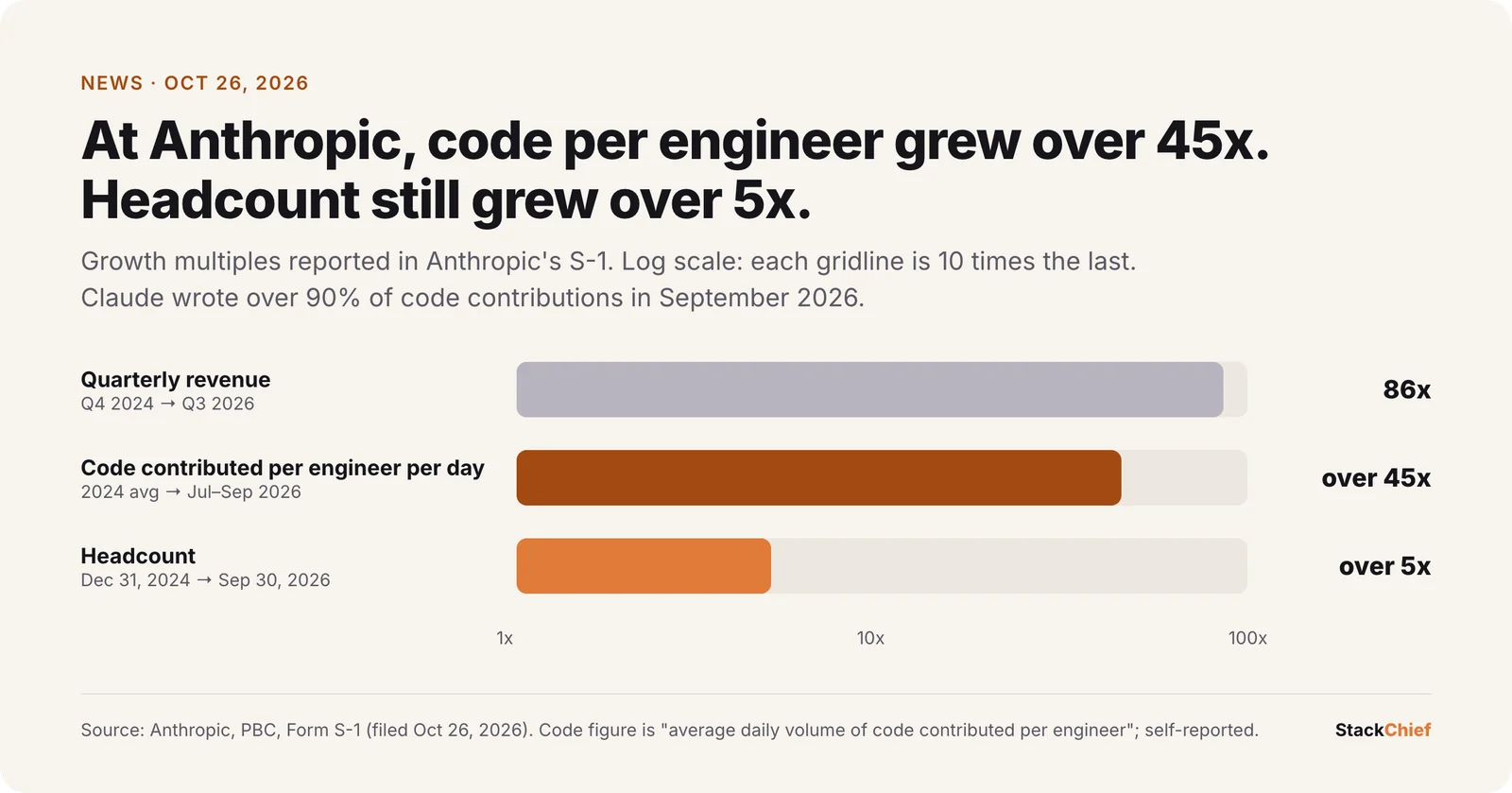
- The filing also says the average daily volume of code contributed per engineer in July–September 2026 was over 45 times the 2024 average.
- Anthropic's headcount grew more than five times between December 31, 2024 and September 30, 2026, to about 5,300 employees as of September 30, 2026. Most of them work in research, engineering and product development.
- The filing says Anthropic expects personnel expenses to keep rising "as we continue to expand our headcount". It also lists AI-generated code as a source of open-source license risk.
- Every figure is self-reported in a sales document, and "volume of code" isn't the same thing as shipped software. A Harvard working paper from October 2026 found that coding agents raised code volume without a significant change in finished work.
The Anthropic S-1 filing, made public on October 26, 2026, puts numbers on how an AI lab's own engineers work, in a document filed with the SEC. According to the filing, Claude wrote over 90% of the code contributions at Anthropic in September 2026. Over the same period, Anthropic's headcount grew more than five times. At the company that makes the agent, the engineers were not replaced. Their job changed to directing and reviewing the agent's work.
What happened
On October 26, 2026, Anthropic announced that it had filed a registration statement on Form S-1 for an initial public offering. It plans to list on the Nasdaq Global Select Market under the ticker "ANT". The share count and price range haven't been set. Most of the filing is about revenue, compute and losses. This post covers the parts of the filing about how software gets built at Anthropic, because those are the parts that matter if you write software for a living.
What the Anthropic S-1 filing says about engineering work
There are five disclosures about engineering. Each is quoted exactly from the prospectus.
| Disclosure | What the filing says | Period |
|---|---|---|
| Share of code written by AI | "over 90% of the contributions to our codebase in September 2026 were written by Claude" | September 2026 |
| Code per engineer | average daily volume of code contributed per engineer "was over 45 times the average daily volume in the year ended December 31, 2024" | 3 months to Sep 30, 2026 vs 2024 |
| How the job changed | "our engineers ... increasingly direct and review its work rather than write code line by line" | 2026 |
| Agent success rate | about 90% on open-ended engineering problems, "up approximately 50 percentage points in nine months, based on our internal benchmarks" | September 2026 |
| Headcount | "our headcount grew over five times"; about 5,300 employees, "a majority of whom work in research, engineering, and product development functions" | Dec 31, 2024 to Sep 30, 2026 |
The filing describes Claude Code moving "from suggesting code to writing and running it directly and working autonomously over long time horizons on complex, multi-step engineering tasks." The benchmark in the table is Anthropic's own, so nobody outside the company can reproduce it.
A prediction, checked in a legal filing
On March 10, 2025, Anthropic CEO Dario Amodei told the Council on Foreign Relations: "I think we'll be there in three to six months—where AI is writing 90 percent of the code." The S-1 now reports that figure for Anthropic's own codebase in September 2026, about 18 months after that talk. It doesn't say the same is true at any other company.
The numbers behind it
The chart above shows the comparison that matters. Code contributed per engineer grew over 45 times. Headcount grew over five times. Quarterly revenue grew 86 times. If code written by agents were simply replacing engineers, headcount would be flat or falling. It wasn't. From September 30, 2025 to September 30, 2026 alone, the filing says headcount rose about 170% while trailing-twelve-month revenue rose about 1,200%.
The filing also puts a dollar figure on the shift. At list prices, the value of Anthropic's own internal Claude usage grew over 250 times from January to September 2026. In April 2026, that monthly value first exceeded Anthropic's monthly personnel expense, excluding stock-based compensation.
What "volume of code" doesn't measure
A line of code isn't a feature. A Harvard working paper by Fiona Chen and James Stratton, based on Jellyfish data from more than 700 firms, found that adopting AI coding agents raised lines of code by 30% and pull requests by 23%. The time from pull request to merge rose 49%, and the rate of resolved Jira issues and epics didn't change in a statistically significant way. The bottleneck moved to review.
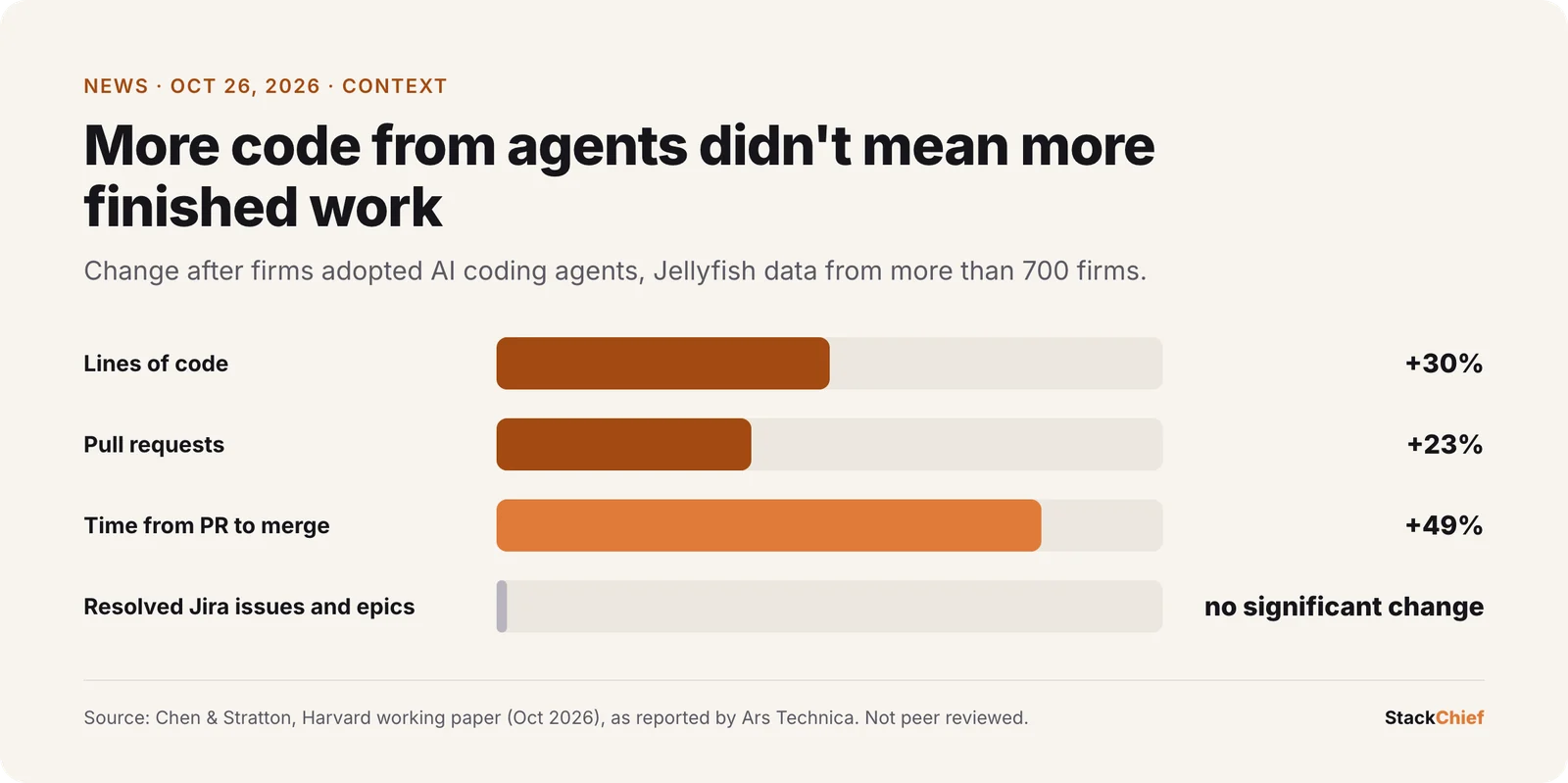
The S-1 and the Harvard paper don't contradict each other. Anthropic reports how much code its engineers contributed, not how many features shipped. Both point to the same change in the job: less typing, more specifying and reviewing.
Headcount growth also hides who got hired. In an October 16, 2026 report on its own workforce, Anthropic said the share of junior-level employees in its technical departments slipped from 21% to 14% since early 2025, and the share of junior technical hires fell from 27% to 9%.
The data has limits. The S-1 is a selling document written by the company that sells the agent. The 90% and 45x figures cover one company whose engineers build the tool and get it first. The filing doesn't define "contribution", doesn't break headcount out by function, and doesn't say how many of the new hires are engineers.
What this means for you
If you're job hunting
- A company where over 90% of code contributions come from an agent is still hiring. The S-1 says it expects personnel expenses to rise "as we continue to expand our headcount". Treat headlines that say agents end engineering hiring as claims to check, not facts.
- The hiring is tilted toward experience. Anthropic's own report shows junior technical hires falling from 27% to 9% of the total. If you're early in your career, show that you can review and verify agent output, not just produce code.
- Expect interviews to test the job the S-1 describes: reading code you didn't write, spotting what's wrong with it and explaining a design. Prepare for code review and system design as much as for writing code from scratch.
If you're a working engineer
- Get fast at review. If agents write most of the code, review time becomes the constraint, as the Harvard data shows.
- Check licenses on generated code. Anthropic's own risk factors say AI-generated code "could incorporate or reproduce open-source software" with copyleft obligations "without our knowledge". If your company ships agent-written code, ask how it scans for that.
- Keep your instruction files current. When agents write most of the code, the files that tell them your conventions matter more. Our October study post shows what happens when coding agents follow stale instruction files.
If you hire or interview
- A take-home or live round that only checks whether someone can produce code measures the part of the job the agent now does. Add a round where the candidate reviews agent output.
How this connects
Our data hub on whether AI will replace software engineers collects the 2026 job and productivity data on that question. The S-1 adds evidence from inside an AI lab: more agent-written code alongside more employees, not fewer. For the market as a whole, see the software engineer job market 2026 numbers. One company's hiring doesn't offset industry layoffs.
The hiring loop is changing in the same direction. Our guide to coding interviews in the age of AI covers which companies now allow AI in rounds and what they score. If you're preparing for those loops, the system design, debugging and communication chapters of Mastering the Tech Interview cover the skills the S-1 says engineers now spend their time on. More AI engineering coverage is in our AI hub.
FAQ
How much of Anthropic's code is written by AI?
According to Anthropic's S-1, filed October 26, 2026, over 90% of the contributions to its codebase in September 2026 were written by Claude. The filing doesn't define a contribution or break the figure out by team.
Did Anthropic cut engineers after adopting Claude Code?
No. The S-1 says headcount grew over five times from December 31, 2024 to September 30, 2026, reaching about 5,300 employees, most of them in research, engineering and product development. It also says the company expects to keep expanding headcount. The mix shifted, though: a separate Anthropic report says junior technical hires fell from 27% to 9% of the total since early 2025.
What does the Anthropic S-1 say engineers do now?
It says Claude Code lets engineers "increasingly direct and review its work rather than write code line by line", and that daily code contributed per engineer was over 45 times the 2024 level in July–September 2026.
Does the S-1 say how much revenue Claude Code makes?
No. The filing doesn't break revenue out by product. It does say that in Q3 2026, the top 5% of Claude Enterprise users who used Claude Code spent about 20 times the under-$75 monthly average of Enterprise users who didn't use it.
Further Reading
- Anthropic, PBC, Form S-1: the prospectus. The engineering figures are in the Prospectus Summary, Business and Our Talent sections.
- Anthropic's filing announcement: the October 26, 2026 announcement with listing details.
- Anthropic, employment at Anthropic (October 16, 2026): the company's report on its junior hiring and agent hours.
- CFR event transcript, March 10, 2025: Dario Amodei's 90% prediction.
- Ars Technica on the Harvard working paper: coding agents and the review bottleneck.
