
Key Takeaways
- Sonar published its State of Code Developer Survey on November 12, 2026: 1,026 developers and engineering managers who use AI coding tools at work, surveyed in September 2026.
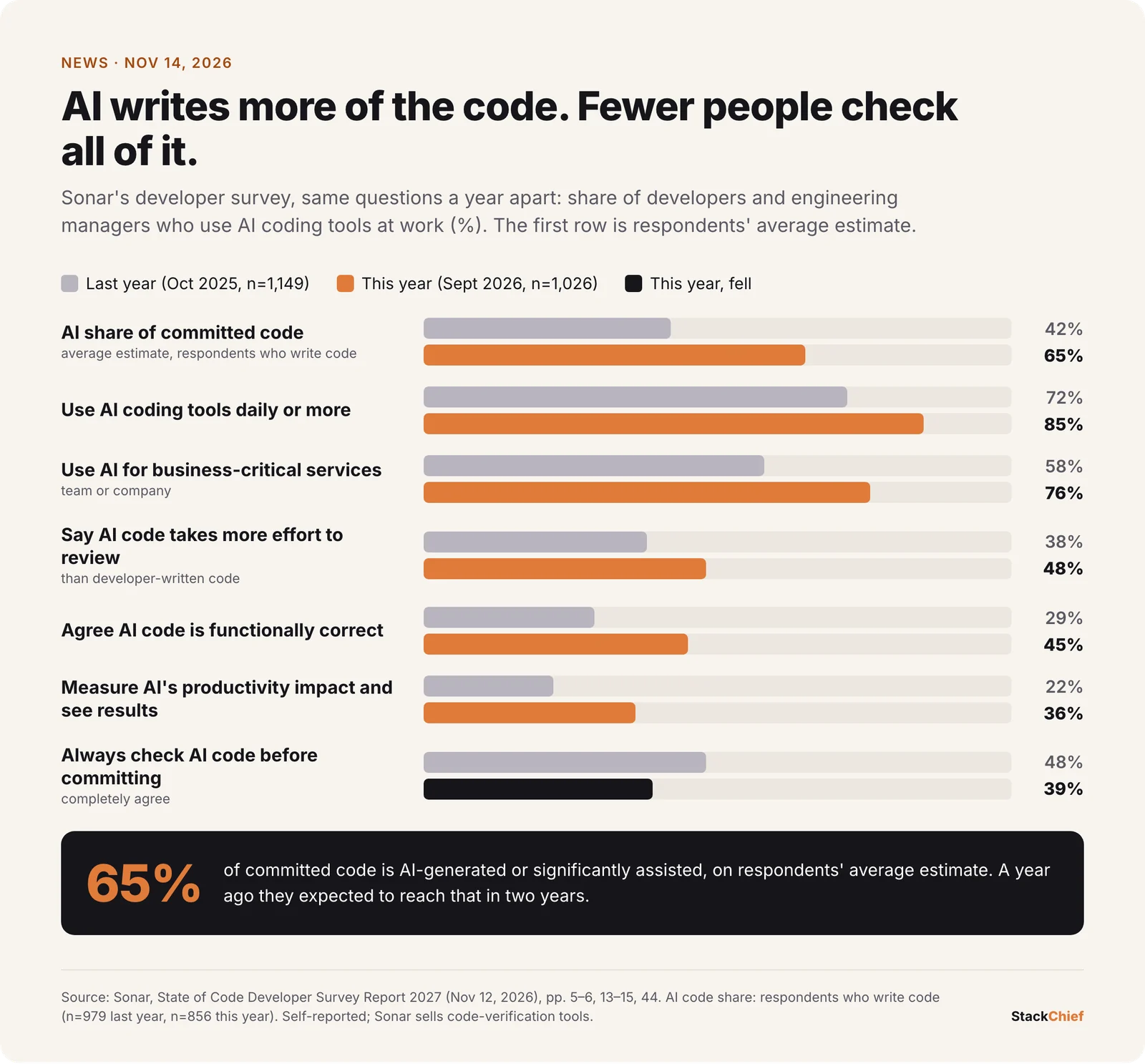
- Respondents say AI generates or significantly assists 65% of the code they commit, up from 42% in the October 2025 survey, when they expected 65% within two years.
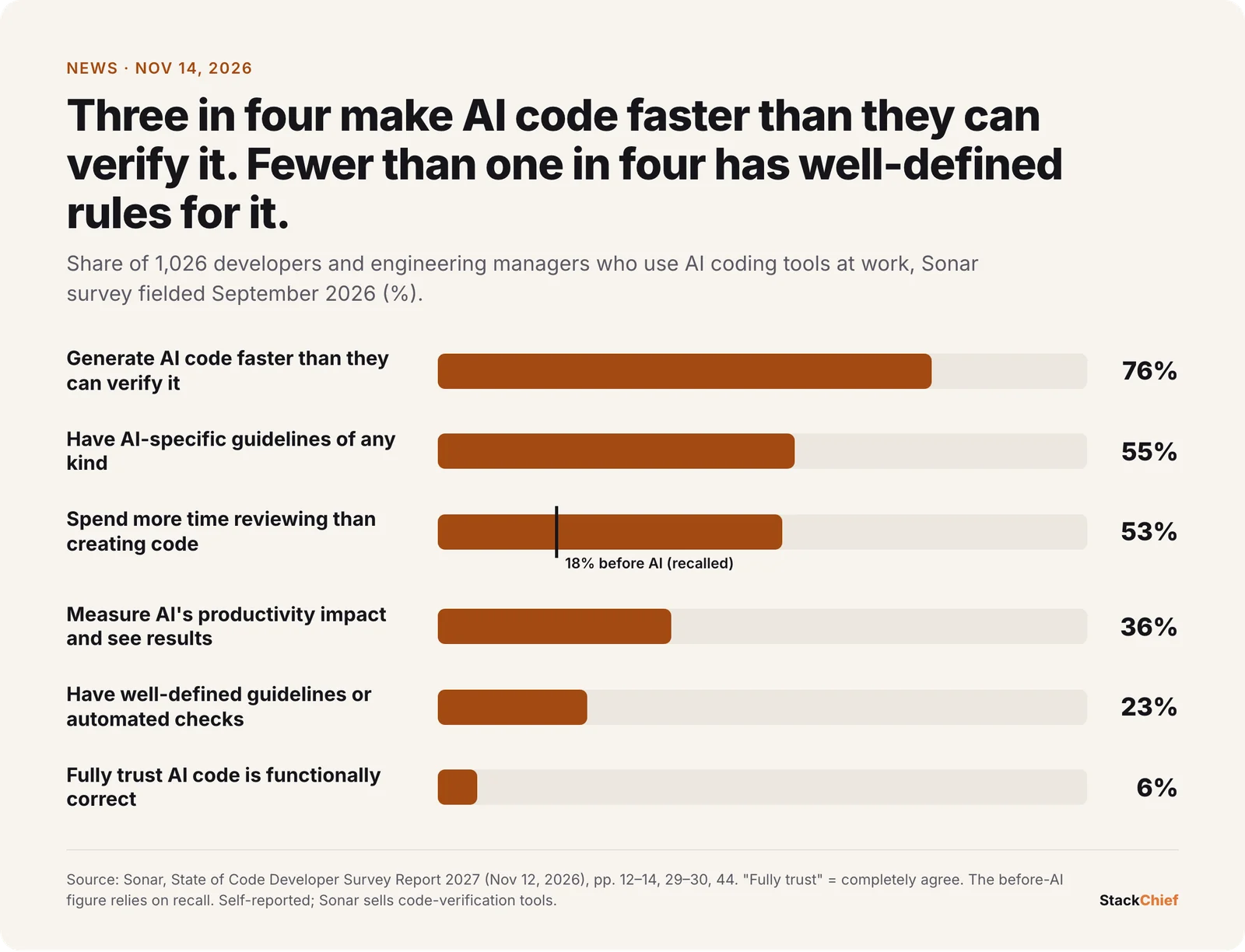
- In the September 2026 survey, 76% agree "we generate AI code faster than we can verify it," and 53% now spend more time reviewing code than creating it, compared with 18% who say that was true before they adopted AI.
- Checking slipped between October 2025 and September 2026 as trust rose: the share who completely agree they always check AI code before committing fell from 48% to 39%, while 45% now agree AI code is functionally correct (29% a year earlier).
- As of September 2026, only 23% describe well-defined guidelines or automated checks for AI code, and 36% say their team measures AI's productivity impact and they can see the results.
The AI code verification survey Sonar released on November 12, 2026 says engineers now produce AI-written code faster than they can check it: 76% of respondents agree with that statement, and 53% spend more of their week reviewing than writing. AI's share of committed code jumped from 42% to 65% in a year. This post sets those self-reported numbers against measured data from three recent studies and turns the gaps into a checklist.
What happened
On November 12, 2026, code-quality vendor Sonar released its second State of Code Developer Survey report (titled for 2027). It is an online survey of 1,026 professional developers and engineering managers who had used AI coding tools for work in the past year, fielded in September 2026. Sonar compares the results with its first survey of 1,149 people, fielded in October 2025, and marks only changes that are statistically significant at 95%.
Sonar's CEO, Tariq Shaukat, summed up the report in the press release: "AI has made code abundant. The challenge now is building confidence in what ships."
The details that matter to engineers
AI hit 65% of committed code a year early
Among respondents who write code, the average estimate of AI-generated or significantly assisted code went from 42% to 65%. Last year the same population predicted 55% within one year and 65% within two. Sonar calls it "A 23-point rise in one year," against an expected 13 points. This year's respondents forecast 76% next.
The tools are daily and in production: 85% use AI coding tools daily or more (72% last year), and 76% say their team uses them for business-critical or mission-critical services, up from 58%. 82% agree they generate more lines of code than before AI, and 55% agree "too many lines of code are being generated with AI," up from 43%.
Review now fills the week
53% of respondents spend more time reviewing code than creating it. Only 18% say that was true before they adopted AI tools, so the share has nearly tripled, though the before figure relies on memory. The share who mostly create code fell from 67% to 34%.
Each review is also heavier. 48% say AI-generated code takes more effort to review than code written by developers, up from 38%, and the figure is 52% at enterprises versus 43% at mid-market companies. One respondent, a software engineer in Asia-Pacific, put it this way: "Developers are increasingly acting as editors and code reviewers rather than authors."
Trust is up, checking is down
45% now agree AI-generated code is functionally correct, up from 29%, though only 6% agree completely. At the same time, the share who completely agree they always check AI code before committing fell from 48% to 39%. 86% rate AI code as comparable to or better than what they write by hand.
The report flags the catch. Concern that AI code is "so well written" that bugs are harder to spot rose from 31% to 42% of respondents who are very or extremely concerned. Polished code that nobody reads closely is the failure mode the numbers point to.
Most teams have rules, few have enforceable ones
55% say their organization has guidelines or quality gates for AI code that differ from those for human code, up from 41%. But only 23% describe them as well-defined or backed by automated checks. Among respondents who say they generate AI code faster than they can verify it, 35% rely on informal guidelines, compared with 22% of everyone else. Measurement is catching up slowly: 36% say their team tracks AI's productivity impact and they can see the results, up from 22% a year earlier.
AI code verification survey vs. measured data
A survey tells you what engineers believe about their own work. Three studies we covered in the last week measured parts of the same picture from logs and repositories. We put them side by side. The populations differ, so read each row as a check on direction, not a like-for-like comparison.
| Question | What Sonar respondents said (Sept 2026) | What measured data shows | Measured source |
|---|---|---|---|
| Is more code being written? | 82% agree they generate more lines than before AI (64% a year earlier) | Lines of code +44.0% after firms adopted agents, on top of assistant gains | Harvard / Jellyfish data, 655 firms |
| Is review taking longer? | 53% spend more time reviewing than creating; 48% say AI code takes more review effort | Submission-to-approval time +56.1% after agent adoption | Harvard / Jellyfish data |
| Is more work getting done? | 35% estimate AI at least doubled their personal productivity | Resolved issues +13.7%, borderline significant; increases above 30.7% ruled out | Harvard / Jellyfish data |
| Is AI code checked before merge? | 39% completely agree they always check it (48% a year earlier) | 41% of teams run any automated check on AI-written code before merge; 81% have merged AI code or tests they didn't fully understand | TestMu AI survey, Nov 13, 2026 (self-reported) |
| Is spend turning into output? | 36% measure AI's productivity impact and see results; 22% unsure what return they've seen | Doubling an engineer's token spend was associated with about 10% more commits | CMU + JetBrains, 404 engineers |
| What happens to unchecked AI code sent to others? | 76% generate AI code faster than they can verify it | 11 of 1,786 PRs that maintainers flagged as AI slop were merged (0.6%) | University of Namur, 76 open-source repos |
Two patterns stand out. Engineers and logs agree that code volume and review time are both up sharply. They disagree on output: a third of respondents feel at least twice as productive, while the Harvard AI coding agents study rules out more than a 30.7% rise in resolved issues. Sonar's own data shows the same gap from another angle: 47% expect a return of 50% or more on AI coding tools, but only 27% report seeing one.
Limits of the data
The sample is senior. 91% are senior individual contributors, managers or directors and above; entry-level and mid-level ICs together are 9%. 46% are in North America and 59% work in technology companies. AI's share of code is each respondent's estimate, ROI and "well-defined" were not defined in the survey, and Sonar's analyst note says group comparisons "show associations, not causation." TestMu AI also sells testing tools, and its sample is drawn from its own community, mostly QA practitioners.
What this means for you
If you write code with AI every day
- Read every AI diff you commit. The drop from 48% to 39% in "always check" is the number to avoid joining. Run it, read it, and know why each line is there.
- Keep changes reviewable. Agents produce volume. Split work so a teammate can review each change in one sitting, and write the PR description yourself.
- Be suspicious of clean code. 42% worry polished AI code hides bugs. Test the edge cases the code doesn't mention.
If you lead a team or review code
- Turn rules into checks. Only 23% of respondents have well-defined guidelines or automated checks for AI code. Put linting, tests, security scans and size limits in CI so they run on every AI change.
- Budget review time openly. If half the week is review, plan sprints that way instead of counting it as overhead.
- Measure delivered work, not volume. In the Harvard data, lines of code and commits rose far faster than resolved issues, and the JetBrains study found token spend a weak proxy for output. Track cycle time, escaped defects and resolved work.
If you're job hunting
Reviewing generated code is now a large part of the job for the senior engineers in this sample. Be ready to show it: walk through a change you caught or rejected, and explain how you verify code you didn't write.
How this connects
This survey adds the engineers' own view to a run of measured studies. The Harvard paper found the review bottleneck in firm data. The AI token spend productivity study found spend is a weak proxy for output. The AI slop pull requests study showed what happens when unverified AI code lands on someone else's desk. What's new here is the scale of the shift in one year, and the admission from three in four respondents that verification isn't keeping up.
For the bigger question of what this does to engineering jobs, see Will AI Replace Software Engineers? What the 2026 Data Actually Says, and for more on building and shipping with AI, the AI engineering hub. Interview loops that allow AI are testing the same skill, reading and correcting generated code; Coding Interviews in the Age of AI covers what changed.
FAQ
How much code is AI writing in 2026?
In Sonar's September 2026 survey, respondents who write code estimated that AI generates or significantly assists 65% of the code they commit, on average, up from 42% in October 2025. It's a self-reported estimate from 856 respondents who write code, mostly senior engineers who use AI tools at work.
Do developers trust AI-generated code?
More than before, but not fully. 45% agree AI-generated code is functionally correct, up from 29% a year earlier, and only 6% agree completely. 94% don't fully trust it, and 42% are very or extremely concerned that well-written AI code makes bugs harder to spot.
Do developers review AI code before committing it?
Fewer say they always do. The share who completely agree they always check AI-generated code before committing fell from 48% to 39% in a year. A separate November 13, 2026 survey by TestMu AI found 41% of teams run any automated check on AI-written code before merge.
Who ran the survey and how reliable is it?
Sonar, which sells code-quality and security tools, ran an online survey of 1,026 developers and engineering managers in September 2026. 91% are senior ICs, managers or directors and above. Year-over-year changes are tested for significance, but the figures are self-reported, and the vendor has a commercial interest in verification.
Further Reading
- Sonar, State of Code Developer Survey Report 2027: the full report, methodology and appendix (November 12, 2026).
- Sonar press release, "Sonar Survey: AI Makes Code Abundant, but Code Confidence Remains Scarce": headline figures and the CEO's comments.
- TestMu AI, State of AI in Quality Engineering 2026: a QA-focused survey with pre-merge check data (November 13, 2026).
- Chen & Stratton, "Artificial Intelligence in the Firm: Bottlenecks in Software Production": the Harvard paper on code volume, review time and output.
- Agarwal et al., "The AI Era's Lines of Code? A Case Study on What an Engineer's Token Spend Measures": CMU and JetBrains on token spend and commits.
- Raskin, Devroey & Vanderose, "An Empirical Study of Maintainer-Identified AI Slop Pull Requests": what maintainers do with unverified AI pull requests.
