
Key Takeaways
- On November 7, 2026, Harvard economists Fiona Chen and James Stratton posted a revised version of their working paper on AI coding tools. It uses Jellyfish data covering 720,542 workers at 655 firms from January 2021 to August 2026.
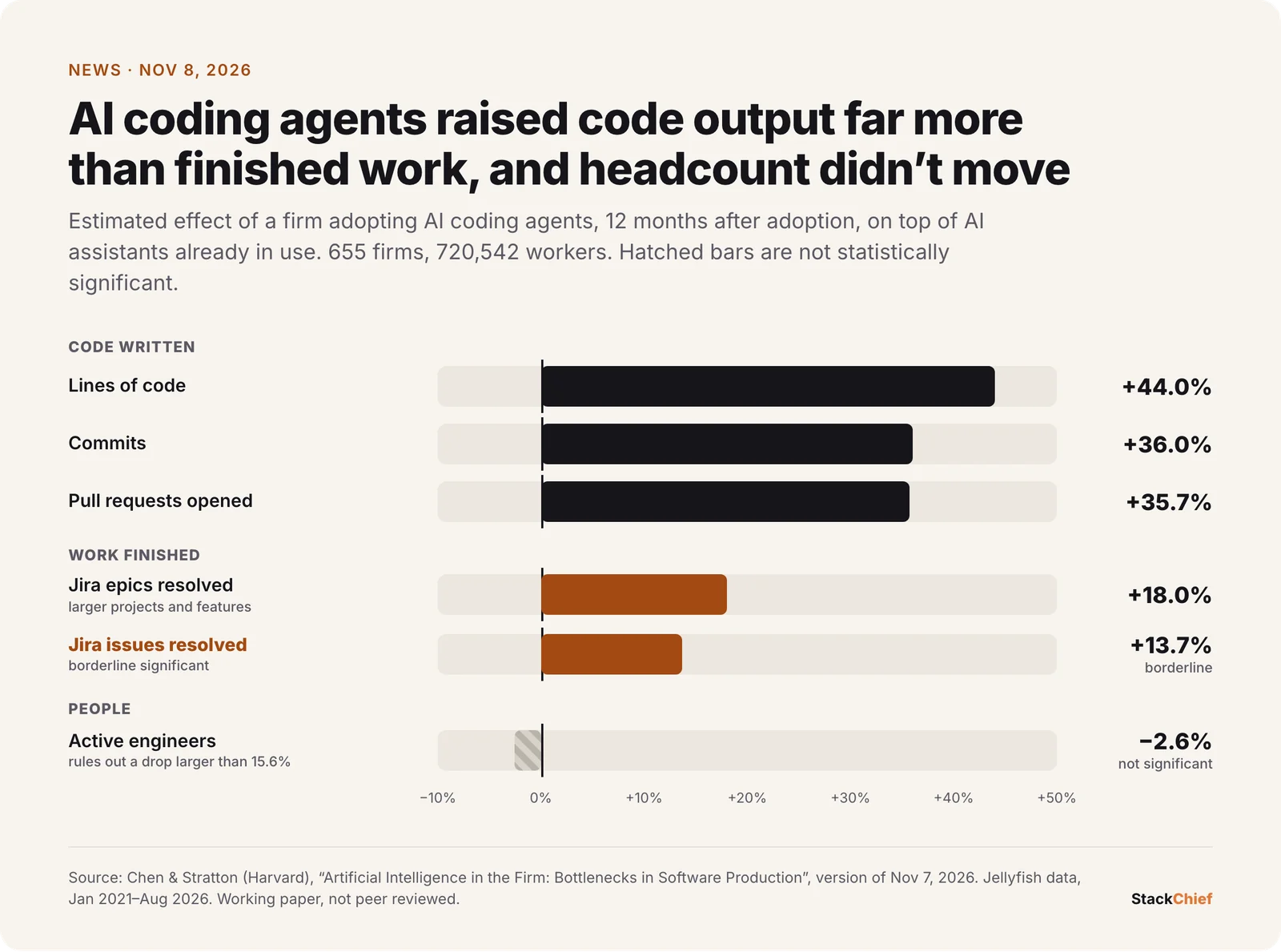
- Twelve months after a firm adopted AI coding agents, pull requests opened rose 35.7% and lines of code 44.0%, on top of AI assistants already in use. Resolved Jira issues rose 13.7%, an effect the authors call borderline significant.
- The paper finds no detectable change in engineering headcount after agent adoption (−2.6%, not significant) and no decline in junior hiring at adopting firms.
- Code review is the bottleneck: after agent adoption, the time from review submission to approval rose 56.1% and comments per code change rose 38.6%.
- The October draft reported no significant rise in finished work. The November 7 version changes that finding, and adds employment scenarios to 2031 that depend on whether review speeds up.
The Harvard AI coding agents study, revised on November 7, 2026, finds that firms using AI coding agents write far more code but finish only modestly more work, and haven't detectably cut engineers. The reason is code review: AI speeds up writing code, but humans still review it, so the queue grows. Below is what changed from the October draft, what the numbers say about jobs, and what to do about it if you write or review code for a living.
What happened
Chen and Stratton, two Harvard PhD economists, posted a new version of "Artificial Intelligence in the Firm: Bottlenecks in Software Production". Its title page reads "Current: November 7, 2026." The paper uses anonymized data from Jellyfish, an engineering analytics platform: 445 million work events from GitHub, Jira and Google Calendar, plus firm and worker usage of GitHub Copilot, Cursor and Claude Code. It compares firms that adopted AI tools earlier with firms that adopted later, which the authors call a staggered difference-in-differences design.
The abstract's conclusion is short: AI "substantially increases code output but has smaller effects on final software output and no detectable effect on employment. Code review becomes the bottleneck."
What the Harvard AI coding agents study changed between drafts
An earlier draft made the rounds in October. Ars Technica reported on October 9 that agents raised lines of code 30% and pull requests 23%, with no statistically significant change in resolved issues. Our own Amazon tokenmaxxing analysis charted those numbers. That October draft is no longer online. The table below sets the figures Ars reported against the November 7 version.
| Measure (AI coding agents) | October draft, as reported by Ars Technica | November 7, 2026 version | What changed |
|---|---|---|---|
| Sample | 700+ firms, 700,000+ workers, 2021 to March 2026 | 655 firms, 720,542 workers, January 2021 to August 2026 | Five more months of data, fewer firms |
| Lines of code | +30% | +44.0% | Larger |
| Commits | +20% | +36.0% | Larger |
| Pull requests | +23% | +35.7% | Larger |
| Jira issues resolved | No significant change | +13.7% (borderline significant) | Now a small positive effect |
| Jira epics resolved | No significant change | +18.0% | Now reported as a point estimate |
| Review time | +49% (PR time) | +56.1% (submission to approval) | Larger; measured as a defined interval |
| Engineering headcount | "cannot attribute significant employment changes to AI" | −2.6%, not significant (rules out a drop larger than 15.6%) | Same conclusion, now with a bound |
| Long-run employment | Not reported | Scenarios from −10.3% to −76.2% by 2031 | New |
Two cautions on reading the table. First, the November agent effects are measured on top of AI assistants, which most adopting firms already used. Assistants alone added 30.4% to lines of code and 20.9% to pull requests. Second, the October definitions come from press coverage, so some differences may reflect measurement rather than new results.
The direction of the story holds, but the size changed. "More code, no more software" was a fair summary in October. In November, output rose a little, about 13.7% against a 35.7% rise in pull requests. The authors also rule out a rise in resolved issues larger than 30.7%.
What it says about jobs
For anyone worried about headcount, this is the section that matters. Across the firms that adopted agents, active engineers changed by −2.6%, which is not statistically significant. The authors also merged the data with LinkedIn profiles: total firm employment showed "zero effects." They found no significant effect on junior or senior employment, and they write, "we do not find the decline in junior hiring documented in prior work." The one exception is a marginally significant rise in senior engineers leaving after agent adoption.
That conflicts with studies that found early-career declines, which the paper cites by name, so treat it as one strong data point, not the final word. The window is also short: the estimates cover the first 12 to 16 months after adoption, and the authors note that employment may respond slowly.
The numbers behind the bottleneck
Engineers spend 30% to 40% of their time writing code, the paper estimates. The rest goes to planning, review, testing and meetings. Agents sped up the first part, so the work piled up in the next step.
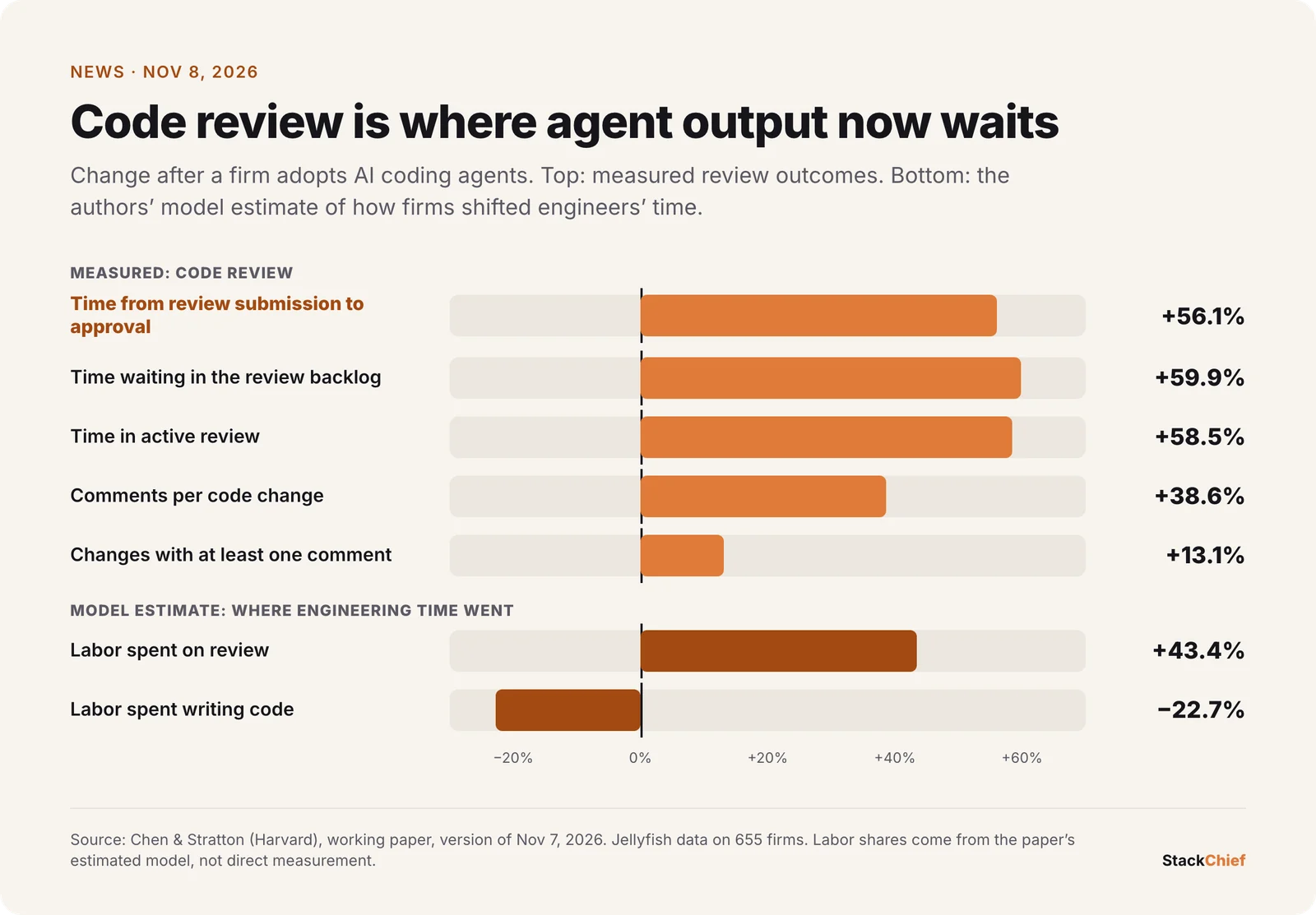
Two things are going on. Code waits longer before anyone looks at it (+59.9%), which points to limited reviewer capacity. And once review starts, it takes longer (+58.5%) and draws more comments, which the authors read as lower-quality code coming in. Review isn't easily shared out, either: 82.8% of reviews go to engineers already familiar with the code, and seniors review 75.7% of senior-written code.
AI review tools haven't closed the gap. 79.1% of firms in the sample adopted one, but humans still write the "overwhelming majority" of reviews and comments. From these estimates, the authors' model infers that agents raised coding productivity 73.7% and lowered review productivity 7.0%. Firms responded by shifting engineers' time: −22.7% on coding, +43.4% on review.
The 2031 scenarios, and their limits
The paper's model also projects ahead. These are model outputs, not measurements, and they rest on assumptions about demand for software and how fast AI improves.
| Scenario (authors' model) | Software output | Engineering employment |
|---|---|---|
| Firms adjust to today's agent gains (typical demand elasticity, 2.27) | +16.1% | −13.2% |
| AI keeps improving, review productivity stays fixed (by 2031) | +57.8% | −10.3% |
| AI keeps improving, review keeps pace with coding (by 2031) | +341.4% | −76.2% |
The authors call the last row an upper bound: it describes a world where AI does "essentially all of software engineering work." Their model has only two tasks, coding and review, and they note that deciding what to build, testing and working with customers would act as further bottlenecks. The middle row extends the bottleneck the paper measures today: in it, output levels off by late 2027, and from late 2028 extra coding speed only adds to the backlog of unreviewed code.
What this means for you
The paper's evidence points to a clear shift: writing code has gotten cheaper, and reviewing it is now the scarce, valuable step. Here's how that plays out for different readers.
If you write code with agents
- Keep agent pull requests small and explained. Review is the step where this data shows work waiting, so every change you make easier to review saves a colleague's time.
- Review your agent's output before a colleague does. The paper reads the longer active-review times as a sign that lower-quality code arrives at review.
- Don't measure yourself by lines or commits. The authors write that such metrics "overstate the gains from AI adoption."
If you review code, especially as a senior
- Your review queue is now where your team's throughput is decided. Make the load visible in planning instead of absorbing it.
- Spread context: reviews go to people who know the code, and juniors do only 24.3% of the reviewing on senior-written code. Bringing juniors into reviews is one way to widen that pool.
If you're job hunting
- Reading and judging code is the skill this data rewards. Expect interview loops to test it; we track how they're shifting in coding interviews in the age of AI.
- Don't read this as "AI isn't affecting jobs." It says adopting firms haven't cut engineers yet. The software engineer job market data still shows a slow, uneven market.
How this connects
Our flagship analysis, will AI replace software engineers, called this study the most rigorous firm-level evidence on that question. The November 7 version strengthens that case. It's a larger, longer dataset, it gives a bound on headcount effects, and it still finds no detectable employment drop. It also shows modest output gains where October showed none. Security is part of the review burden too: our AI-generated code security study coverage found agent code that passes tests but stays exploitable, which is exactly what a reviewer has to catch.
If the skill now in short supply is judging code under time pressure, that's also what technical interviews test. Mastering the Tech Interview covers the coding, debugging and system design rounds where that judgment gets assessed.
FAQ
What did the Harvard study on AI coding agents find?
In the November 7, 2026 version, Chen and Stratton find that a year after firms adopted AI coding agents, pull requests opened rose 35.7% and lines of code 44.0%, but resolved Jira issues rose only 13.7% (borderline significant). They found no detectable change in engineering headcount. Code review became the bottleneck.
Are AI coding agents reducing software engineering jobs?
Not detectably at the 655 firms studied, through August 2026. The estimated headcount effect is −2.6% and not significant, and the paper finds no decline in junior hiring at adopting firms. Its model projects employment declines by 2031 under some scenarios, from −10.3% to an upper bound of −76.2%.
Why don't AI coding agents increase software output more?
The paper points to code review. After agent adoption, the time from review submission to approval rose 56.1%, and comments per code change rose 38.6%. Humans still write most reviews, even though 79.1% of firms adopted AI code review tools.
Is the Harvard Jellyfish study peer reviewed?
No. It is a Harvard job market working paper, first posted January 7, 2026 and revised November 7, 2026. Jellyfish supplied the data and reviewed the manuscript only for proprietary information, not its scientific content.
Further Reading
- Chen & Stratton, "Artificial Intelligence in the Firm: Bottlenecks in Software Production" (version of November 7, 2026): the full paper, with event studies, review data and the 2031 simulations.
- Ars Technica, "AI coding agents generate more code, but not more software" (October 9, 2026): coverage of the earlier draft.
