
Key Takeaways
- On November 9, 2026, Anthropic released Claude Fable 5.2 and Claude Mythos 5.2, priced at $8 per million input tokens and $40 per million output tokens. That is 20% below Fable 5.1 and still twice the price of Claude Opus 5.5.
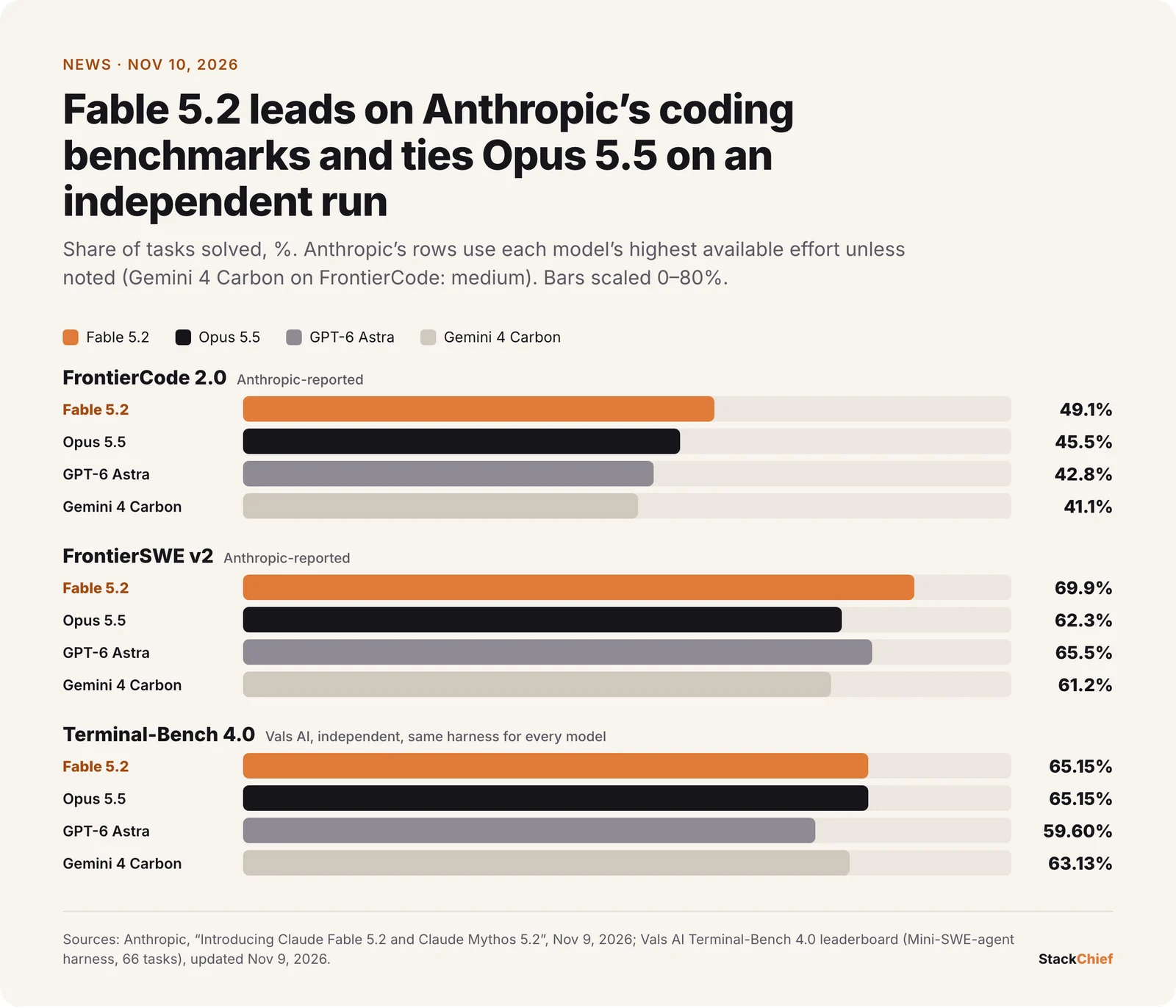
- On Anthropic's own coding benchmarks, Fable 5.2 leads every model it lists: 49.1% on FrontierCode 2.0 (Opus 5.5: 45.5%) and 69.9% on FrontierSWE v2 (Opus 5.5: 62.3%).
- On Vals AI's independent Terminal-Bench 4.0 run, updated November 9, Fable 5.2 and Opus 5.5 tie at 65.15%. Fable costs $14.56 per task attempt against $12.04 for Opus, but finishes about 9 minutes sooner.
- The same day, Claude Code 2.1.321 made Fable 5.2 the default Fable model, and GitHub Copilot added it for Pro+, Max, Business and Enterprise users.
- Anthropic still recommends Opus 5.5 as the starting model "for most coding and knowledge tasks." The largest Fable 5.2 gains are on long, multi-hour agent work.
Claude Fable 5.2 coding benchmarks show a clear lead on Anthropic's own tests and a tie on the first independent retest. The gap between those two results decides whether you should switch. Below are the numbers side by side, what each model costs per solved task, and a short guide to which model to pick in Claude Code or Copilot this week.
What happened
Anthropic announced Claude Fable 5.2 and Claude Mythos 5.2 on November 9, 2026. The two are the same underlying model. Fable ships with stronger cybersecurity and biology safeguards and is available to everyone, including on AWS, Google Cloud and Microsoft Azure. Mythos is limited to organizations approved through Anthropic's verification programs. Anthropic says both generate output "up to 30% faster than Claude Fable 5.1."
Developer tools picked it up the same day. Claude Code 2.1.321 added claude-fable-5-2 as "the default Fable model," with a 1M-token context window. Saved Fable 5.1 picks move to the new model at once on Pro and Max plans, and on Team and Enterprise plans once the organization allows it. /model claude-fable-5-1 switches back. GitHub's changelog lists it in the Copilot model picker across VS Code, JetBrains, the Copilot CLI and the Copilot coding agent, billed at provider list pricing.
Claude Fable 5.2 coding benchmarks against Opus 5.5 and Fable 5.1
Anthropic's table compares Fable 5.2 with Fable 5.1, Opus 5.5, OpenAI's GPT-6 Astra and Google's Gemini 4 Carbon. The page notes that each score uses "each model's highest-available effort unless otherwise noted." The table below keeps only the rows that matter for software work, adds Vals AI's independent result, and computes the gaps. The gap columns are ours.
| Benchmark | Fable 5.2 | Opus 5.5 | Fable 5.1 | Fable 5.2 vs Opus 5.5 | Fable 5.2 vs Fable 5.1 |
|---|---|---|---|---|---|
| FrontierCode 2.0 (Anthropic) | 49.1% | 45.5% | 32.4% | +3.6 pts | +16.7 pts |
| FrontierSWE v2 (Anthropic) | 69.9% | 62.3% | 56.3% | +7.6 pts | +13.6 pts |
| OSWorld 2.1, computer use (Anthropic) | 89.3% | 87.2% | 83.5% | +2.1 pts | +5.8 pts |
| Remote Labor Index (Anthropic) | 41.3% | 21.3% | 17.9% | +20.0 pts | +23.4 pts |
| Terminal-Bench 4.0 (Vals AI, independent) | 65.15% | 65.15% | 58.08% | 0.0 pts | +7.07 pts |
| API list price, output per million tokens | $40 | $20 | $50 | 2x | −20% |
Two patterns stand out. Against Fable 5.1, the new model is better on every row and cheaper, so the upgrade is simple. Against Opus 5.5, the lead depends on how long the task is. It's largest on the Remote Labor Index, which measures long freelance-style projects, and smallest on bounded coding tasks. Anthropic's own write-up adds a telling detail: on FrontierCode at High effort, Fable 5.2 "scores about the same as Opus 5.5's best score (45.3% vs. 45.5%)" for "roughly half the cost per task."
The model doesn't win everything. On AutomationBench, a business-workflow test, Gemini 4 Carbon scores 53.9% to Fable 5.2's 51.4%.
What the independent retest shows
Vals AI ran Terminal-Bench 4.0, 66 new community-contributed terminal tasks, on every model with the same open-source harness (Mini-SWE-agent). Fable 5.2 and Opus 5.5 both scored 65.15%. Sonnet 5.5 was one point behind at 64.14%. That is a neutral harness, not Claude Code or Copilot, so it shows the model rather than the product. It's also one benchmark, published on release day.
Jonathan Chavez of LLM Stats summed up the launch numbers this way: "On bounded coding the lead is thin or negative, and the model still costs twice Opus 5.5."
The numbers behind the price
Per-token price only tells half the story, because models use different numbers of tokens for the same job. Vals reports the average cost of each task attempt. Dividing that by the pass rate gives the cost per solved task, which is what you actually pay for.
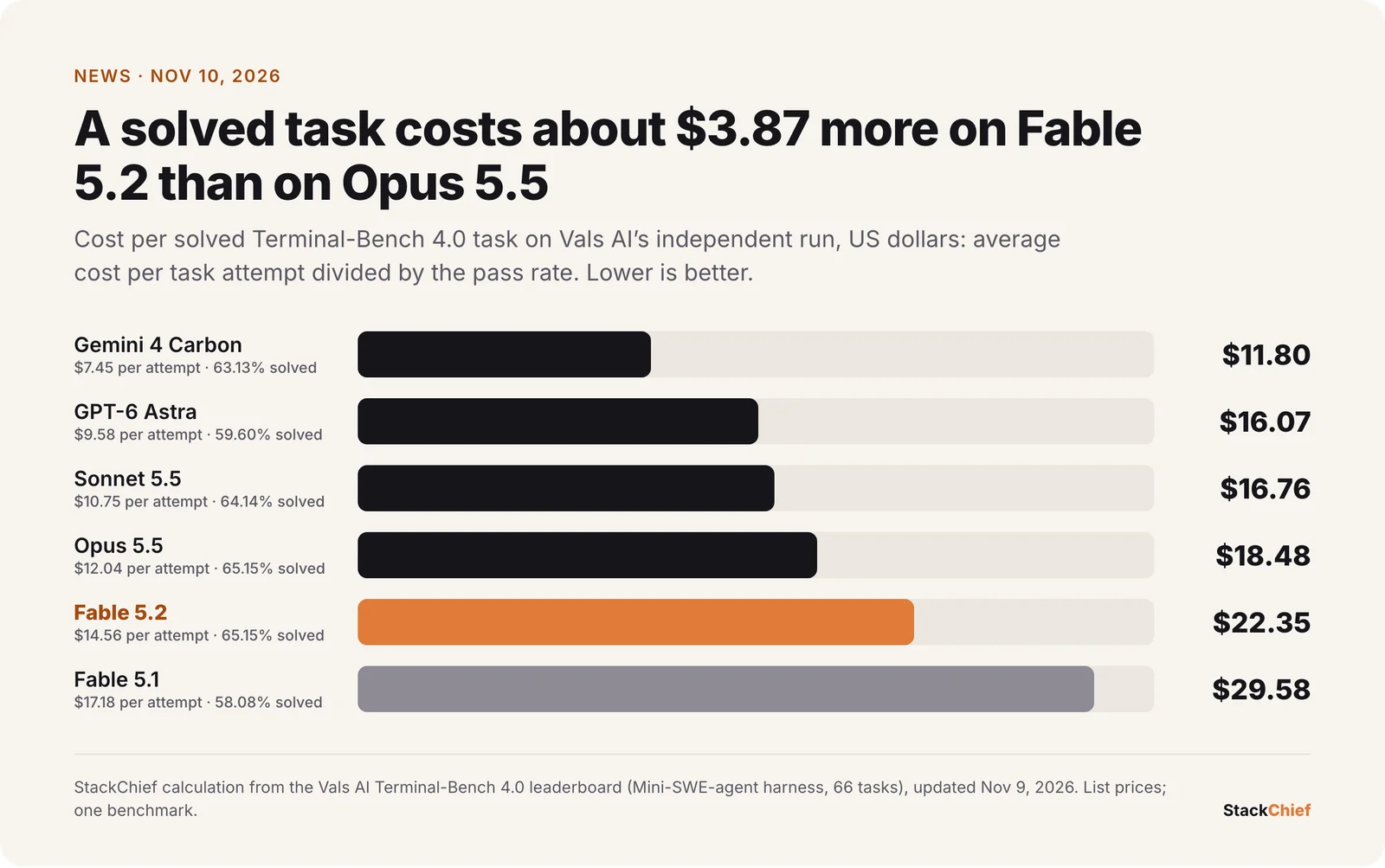
On that measure, Fable 5.2 costs $22.35 per solved task, against $18.48 for Opus 5.5 and $29.58 for Fable 5.1. Gemini 4 Carbon is the cheapest model in the chart at $11.80, with a 63.13% pass rate. Fable 5.2 was the fastest Claude model in the run, at 55 minutes 7 seconds per task attempt against 1 hour 4 minutes for Opus 5.5.
A rough list-price example, with no caching: a coding-agent session that reads 200,000 tokens and writes 20,000 costs $2.40 on Fable 5.2, $1.20 on Opus 5.5 and $0.60 on Sonnet 5.5. Prompt caching changes this a lot in practice. Fable 5.2 and Opus 5.5 both charge $0.20 per million cached input tokens, so on long sessions that reread the same repository, the gap narrows.
The limits of this data: Anthropic's benchmarks are self-reported. Several, such as FrontierSWE v2 and the Remote Labor Index, are new and have few independent runs. Vals' result is a single benchmark with 66 tasks, where one task is worth about 1.5 points.
What this means for you
Anthropic's own guidance is unusually direct: "For most coding and knowledge tasks, we recommend that users start with Claude Opus 5.5, our strongest daily driver." The data above supports that. Here is how it maps to everyday work.
| Your task | Model the data points to | Why |
|---|---|---|
| Everyday feature work, bug fixes, reviews | Opus 5.5 | Tied with Fable 5.2 on the independent run at half the per-token price |
| Multi-hour agent runs, migrations, large refactors | Fable 5.2 | Largest leads (FrontierSWE v2 +7.6 pts, Remote Labor Index +20.0 pts) are on long tasks |
| Anything you were running on Fable 5.1 | Fable 5.2 | Better on every row, 20% cheaper per token, $7.23 less per solved task on Vals |
| High-volume or cost-capped automation | Sonnet 5.5 or Gemini 4 Carbon | Within about two points on Terminal-Bench 4.0 at a lower cost per solved task |
- Claude Code users: if you had Fable 5.1 selected on a Pro or Max plan, you're on Fable 5.2 now; Team and Enterprise users move once their organization allows it. Medium effort is the default, and Anthropic says Fable 5.2 can finish hard tasks "with fewer tokens than Fable 5.1" there. Check
/modelbefore a long session rather than assuming. - Copilot Business and Enterprise teams: the policy is off by default. An admin has to enable it, and GitHub notes the model requires data retention by default for Anthropic's safety classifiers.
- Anyone paying per token: run your own 10–20 representative tasks on both Opus 5.5 and Fable 5.2 before switching a pipeline. Release-day benchmarks may not reflect your repository.
How this connects
Anthropic's announcement echoes the figure in its S-1 filing: "Over 90% of the changes merged into Anthropic's core codebase are now written by Claude (with human guidance)." A stronger model doesn't remove the review step, though. The Harvard AI coding agents study found that faster code generation mostly moved the bottleneck to human review. Model quality also isn't the only thing your agent depends on: coding agents follow stale instruction files over the code in front of them, whichever model runs underneath. For more on choosing and running these tools, see the StackChief AI hub.
Model choice also comes up in interviews now. "Which model would you use for this, and why?" is a fair question in an AI engineering loop, and a strong answer is the one above: measure cost per solved task, not price per token. Our LLM interview questions guide covers how to answer that and related evaluation questions.
FAQ
Is Claude Fable 5.2 better than Opus 5.5 for coding?
On Anthropic's own benchmarks, yes: 49.1% vs 45.5% on FrontierCode 2.0 and 69.9% vs 62.3% on FrontierSWE v2. On Vals AI's independent Terminal-Bench 4.0 run, the two tie at 65.15%. Anthropic itself recommends starting with Opus 5.5 for most coding tasks.
How much does Claude Fable 5.2 cost?
$8 per million input tokens and $40 per million output tokens, with cache reads at $0.20 per million. Fast mode costs $16 and $80. That's 20% less than Fable 5.1 ($10/$50) and twice Opus 5.5 ($4/$20).
Is Claude Fable 5.2 the default model in Claude Code?
It's the default Fable model as of Claude Code 2.1.321, released November 9, 2026. Saved Fable 5.1 picks move to Fable 5.2 at once on Pro and Max plans, and on Team and Enterprise plans once the organization allows it. You can switch back with /model claude-fable-5-1. Opus 5.5 and other models are still available in the model picker.
Can I use Claude Fable 5.2 in GitHub Copilot?
Yes, on Copilot Pro+, Max, Business and Enterprise plans, as of November 9, 2026, with a gradual rollout. Business and Enterprise admins must turn on the Claude Fable 5.2 policy first. Usage is billed at provider list pricing.
Further Reading
- Anthropic, "Introducing Claude Fable 5.2 and Claude Mythos 5.2" (November 9, 2026): the announcement and full benchmark table.
- Claude API pricing: current per-token, cache, batch and fast-mode prices.
- Vals AI, Terminal-Bench 4.0 leaderboard: independent scores, cost and time per task.
- Claude Code changelog: version 2.1.321 notes.
- GitHub changelog, "Claude Fable 5.2 in GitHub Copilot" (November 9, 2026): plans, surfaces and admin policy.
- LLM Stats, launch analysis (November 9, 2026): a critical read of the benchmark table.
